
Why Memory Foam Mattresses Get Hot: Causes & Fixes

Table of Contents
- Why Memory Foam Mattresses Get Hot
- Dense Foam and Closed-Cell Structure
- Does Memory Foam Trap Heat?
- Memory Foam Mattress Ventilation: How Airflow Works
- How to Make a Memory Foam Mattress Sleep Cooler
- Cooling Mattress Topper for Memory Foam: What It Can and Cannot Do
- Bedding, Foundation, and Sleep Environment
- When to Replace or Return a Mattress
- Frequently Asked Questions
Last Updated: October 7, 2026
Why Memory Foam Mattresses Get Hot
Memory foam mattresses get hot because dense foam traps your body heat instead of letting it escape. The foam’s closed-cell structure limits airflow, and your body contact with the surface adds warmth that has nowhere to go. This guide from Nomad Mattress explains the causes and gives you a practical plan to sleep cooler.
Heat buildup is the top complaint we hear from RVers and truck drivers, and a warm cab makes it worse.
Dense Foam and Closed-Cell Structure
Dense foam holds heat because air cannot move through it easily. Traditional memory foam has a closed-cell structure: the tiny pockets inside are sealed, so your body heat warms the foam and stays put. Lower-density and open-cell foams let more air pass through, and that airflow carries heat away.
Body Contact, Contouring, and Heat Buildup
Memory foam is designed to contour to your body. That contouring is great for pressure relief, but it creates more surface contact, so more heat transfers from your skin to the mattress. A mattress that hugs every curve leaves fewer gaps for air to circulate, and in a warm cab those trapped pockets add up fast.
Does Memory Foam Trap Heat?
Yes, memory foam traps heat, but not all memory foam does it equally. It depends on foam density, cell structure, and how the mattress is built, but the bigger variable is what surrounds the foam.
How construction changes heat retention
Memory foam is rarely the whole mattress. It is usually a comfort layer over a support core, and that core decides where heat can go.
- All-foam mattresses: Every layer is foam, so there is no open structure for air to move through. Heat escapes only through the edges and top surface, so these sleep warmest, especially in a small space.
- Hybrid mattresses: A coil core under the foam creates open space for air to move and heat to rise away. Hybrids usually sleep cooler than all-foam, but the foam comfort layer can still feel warm.
- Latex mattresses: Latex has an open-cell structure by nature, so air moves through it more freely than memory foam, and it feels cooler to the touch. The trade-off: latex is bouncier and less contouring.
- Innerspring mattresses: The most airflow of any design, because coils leave large open spaces. They sleep coolest, but offer the least pressure relief and contouring.
The more solid material between you and the air, the more heat stays put, which is why memory foam has the reputation it does.
How temperature changes firmness and responsiveness
Memory foam softens as it warms up. In a cool room it feels firmer and responds more slowly; as it absorbs your body heat, it softens and contours more. This creates a loop: the warmer the foam gets, the more it hugs you, and the more it hugs you, the more heat it traps. A cooler sleep surface helps the foam stay closer to its intended firmness.
How to tell which layer is the problem
A simple test: lie on the mattress for 20 minutes in a cool room with a light sheet. If the surface feels warm but the mattress underneath stays neutral, your bedding or room is the issue. If the whole mattress feels warm after you get up, the core is holding heat.
This is why Nomad Mattress builds around a Thermo-Adaptive top layer rather than relying on gel alone. The Original Nomad RV pairs a 2″ (5 cm) Thermo-Adaptive top with a transfer edge that lets air move at the perimeter, and the Nomad Slim uses a 1″ (2.5 cm) cooling memory foam top over a firmer two-layer core. The difference is not the brand name, it is where the air can go.
Memory Foam Mattress Ventilation: How Airflow Works
Ventilation is the most underrated fix for a hot memory foam mattress. Air needs a path to move under and through the mattress; if the foam sits flat on a solid surface, heat has nowhere to go.
Here is what actually helps airflow:
- A breathable foundation or slatted base instead of a solid platform
- A mattress protector that lets air pass through
- Space between the mattress and the wall or cabinet
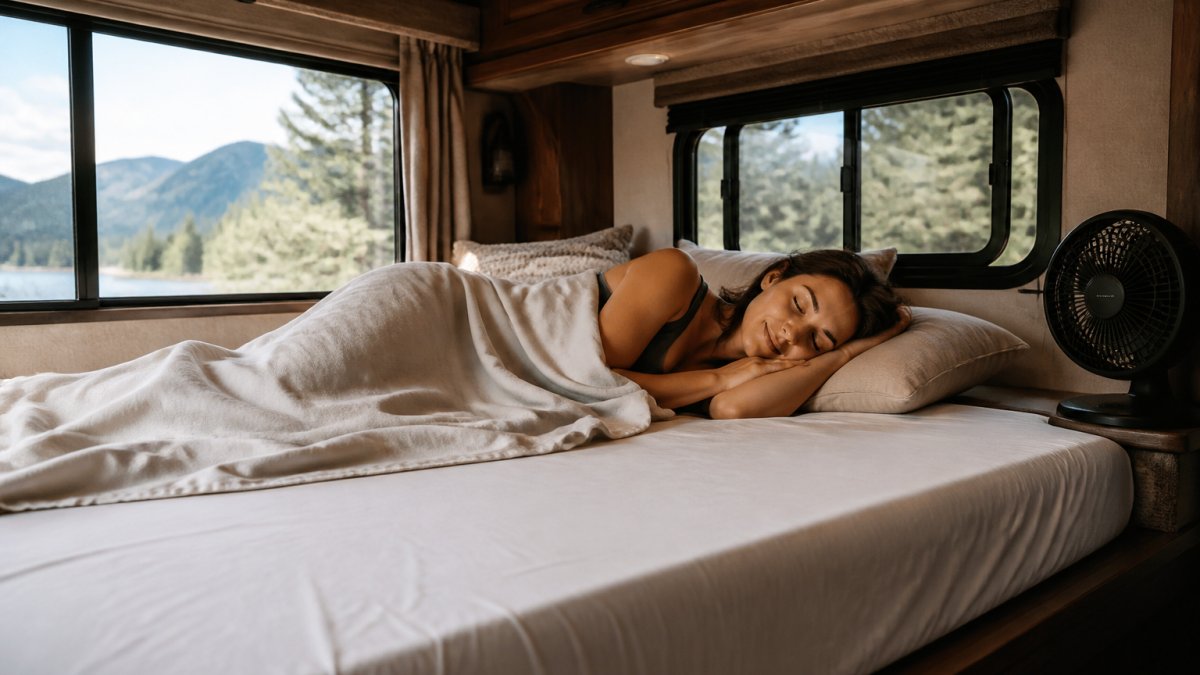
- A small fan moving air across the sleep surface
Memory foam mattress ventilation works best when air enters at the edges and exits somewhere else. In an RV or sleeper cab, even a few inches of clearance can make a difference.
How to Make a Memory Foam Mattress Sleep Cooler
You can make a memory foam mattress sleep cooler by fixing the biggest heat sources first. Most people start with the wrong step, like buying new sheets, when the real problem is airflow or the foam itself.
Work through this list in order. Stop when the mattress feels comfortable.
A Prioritized Troubleshooting Checklist
- Step 1: Check your bedding. Swap heavy sheets and thick protectors for breathable cotton or linen. Cheapest fix, often the fastest.
- Step 2: Improve airflow under the mattress. Add a slatted base or breathable foundation if yours is solid.
- Step 3: Cool the room or cab. A fan or small air conditioner lowers the ambient temperature, helping the foam stay firmer and cooler.
- Step 4: Add a cooling topper. A gel-infused or phase-change topper can help, but read the next section before you buy.
- Step 5: Consider a cooler mattress. If the foam itself is the problem, a mattress built with temperature-regulating foam is the real fix.
Cooling Mattress Topper for Memory Foam: What It Can and Cannot Do
A cooling mattress topper for memory foam can help, but it cannot fix a mattress that traps heat at its core. A topper adds a cooler surface layer; it does not change what happens inside the foam below.
Gel infusions
Gel particles are mixed into the foam to pull heat away from the surface and spread it sideways. In practice, gel can make the first 20 to 30 minutes feel cooler; after that, it reaches the same temperature as your body and stops absorbing heat. Gel helps with the initial “hot flash” feeling when you lie down, but it does not lower your temperature across the night.
Phase-change materials (PCMs)
Phase-change materials absorb heat while they change from solid to liquid at a set temperature, then release it as they cool back down. A PCM topper or cover can smooth out short temperature swings, which is why some sleepers notice a more even feel early in the night. The catch is capacity: once the PCM has absorbed all it can, it must cool down before it works again, and in a warm cab that reset may not happen until morning.
Open-cell and breathable foams
Open-cell foam has broken cell walls, so air moves through the foam instead of being sealed inside it. This is the most durable cooling approach, because it works every night without wearing out. It will not make a mattress feel cold, but it lets heat escape instead of holding it. This is the mechanism behind the Thermo-Adaptive top layer on the Original Nomad RV and the Nomad Truck, and the Cool Gel-Flex top on the Home & Cottage.
Breathable covers and covers with airflow channels
A cover with a knit or mesh structure moves moisture and warm air away from your skin. It is a small effect on its own, but it stacks with the layers above it. A zip-off, machine-washable cover also lets you clean the surface that collects sweat and oils, keeping airflow consistent over time. Every Nomad Mattress model uses this type of cover.
What none of these can do
- Stop a dense, closed-cell foam core from holding heat
- Fix poor airflow under the mattress
- Overcome a hot cab or a sun-baked RV
- Replace the need for a cooler room or moving air
How phase-change materials work in bedding
If you want a cooling layer that lasts, look for open-cell foam or a breathable cover rather than a gel pad that only feels cool for the first half hour.
Bedding, Foundation, and Sleep Environment
Your sleep environment often matters as much as the mattress. Fix it first, because it is cheaper and easier than replacing a mattress.
Start with these:
- Sheets: Breathable cotton or linen beats synthetic blends
- Protector: Choose one labeled breathable, not waterproof-and-sealed
- Foundation: Slats or a breathable base beat a solid platform
- Air movement: A fan near the bed helps more than most people expect
- Room temperature: Cooler rooms keep foam firmer and reduce heat buildup
For RVers and truck drivers, the cab itself is a big factor. A parked rig in the sun can hit high temperatures inside, so shade, ventilation, and window coverings all help before you even touch the mattress.
When to Replace or Return a Mattress
Replace or return a mattress when cooling fixes stop working. If you have improved airflow, swapped bedding, added a fan, and tried a topper, and you still sleep hot, the foam is the problem.
Signs it is time to move on:
- The mattress stays warm for hours after you get up
- You wake up sweating even in a cool room
- The foam has softened and lost its shape
- You have had the mattress for years and it no longer supports you
At Nomad Mattress, we build our mattresses with Thermo-Adaptive foam that helps regulate temperature instead of trapping it. Our Original Nomad RV comes in nine standard RV sizes, and our lineup covers everything from sleeper cabs to cottages. If your space is an unusual shape, email info@nomad-mattress.com with your measurements and a photo, and we will point you to the closest standard size.
Every Nomad Mattress includes a sleep trial, so you can test it in your own rig before you commit. Shipping is free to most areas in Canada.
Sleeping hot is one of the most common reasons people give up on a memory foam mattress, but heat is usually fixable. At Nomad Mattress, we build Canadian-made mattresses with Thermo-Adaptive foam, a zip-off washable cover, and standard sizes for RVs and sleeper cabs.
Frequently Asked Questions
Why do memory foam mattresses get hot?
Memory foam mattresses get hot because dense foam and closed-cell structures limit airflow, while the foam contours to your body and traps heat. Body contact and pressure relief reduce ventilation, so heat builds up rather than dissipating. Room temperature and humidity also play a role, especially in small spaces like RVs or truck cabs where ambient heat rises.
Does memory foam trap heat?
Yes, traditional memory foam can trap heat because its dense cellular structure and contouring reduce airflow. However, not all memory foam is the same. Open-cell foams and those with cooling gel or phase-change materials allow better heat transfer. Nomad Mattress uses Thermo-Adaptive foam in models like the Original Nomad RV to regulate temperature more effectively.
How can I make a memory foam mattress sleep cooler?
Start with a breathable mattress protector and moisture-wicking sheets. Improve ventilation by using a slatted foundation or a breathable mattress base. Keep the room cool and use fans to circulate air. If heat persists, consider a mattress with open-cell or gel-infused foam, such as those from Nomad Mattress.
Do cooling mattress covers help with memory foam heat?
Cooling mattress covers can help by wicking moisture and improving surface airflow, but they cannot change the foam’s internal heat retention. They work best as part of a broader strategy that includes bedding, ventilation, and room temperature control. For significant relief, pair a cooling cover with a mattress that uses phase-change materials or open-cell foam.