
Why Memory Foam Gets Hot in RVs: Solutions

Table of Contents
- Why Memory Foam Retains Body Heat
- Breathability, Airflow, and Density in Memory Foam
- Temperature Sensitivity and Foam Firmness in Mobile Living
- Benefits of Gel-Infused and Cooling Mattress Toppers for RVs
- How to Keep an RV Cool at Night Beyond Mattress Choice
- Thermo-Adaptive Foam Benefits for Temperature Regulation
- Practical Steps to Address Heat Issues in Your RV Mattress
- Frequently Asked Questions
Last Updated: September 28, 2026
Why Memory Foam Retains Body Heat
Memory foam gets hot because of how it’s engineered at the molecular level. The material is made from viscoelastic foam, a dense, temperature-sensitive polymer that responds to your body heat by softening and conforming to your shape. This conforming action traps heat around your body instead of allowing it to dissipate into the air.
The problem intensifies in an RV environment. RVs have limited airflow compared to traditional homes, and the confined sleeping space amplifies heat buildup. The foam’s thermal conductivity, its ability to move heat away from the surface, is naturally low, which is why it feels warm to the touch during summer months.
The denser the memory foam, the more heat it retains. Lower-density foam allows slightly more airflow, but density alone won’t solve the problem in an RV’s constrained environment.
The viscoelastic foam structure and thermal conductivity
Viscoelastic foam contains closed-cell structures that limit air circulation within the material. This design makes memory foam excellent for pressure relief and support in truck sleeper cabs and RVs, but at the cost of heat retention.
Standard memory foam has low thermal conductivity, meaning heat moves slowly away from your body. In a hot RV, your body heat enters the foam, warms it, and that warmth radiates back toward you rather than dissipating into the air.
How RV environments amplify heat retention
An RV’s sleeping quarters are smaller with thinner insulation and limited ventilation compared to a bedroom at home.
The mattress sits on a bed platform with minimal air circulation underneath, and close walls reflect body heat back onto the sleeping surface. This combination of confined space and reduced airflow makes memory foam’s heat retention far more noticeable than in a standard bedroom.
Breathability, Airflow, and Density in Memory Foam
Breathability refers to how easily air moves through the material and moisture escapes from the sleep surface. Memory foam scores poorly because its closed-cell structure resists airflow, and density directly affects how much air can pass through it.
Higher-density memory foam (5 to 6 pounds per cubic foot) offers better support and durability for RVs and trucks, but reduces breathability. Lower-density foams allow more airflow but compress more easily and won’t last as long in a moving vehicle.
Standard memory foam forces a trade-off between support and breathability. The bed platform underneath matters as much as the foam itself. A slatted bed base allows air to circulate beneath the mattress, pulling heat away. A solid platform traps air underneath, creating a heat pocket that amplifies heat retention. Even high-breathability foam will feel hot on a solid platform.
An RV with a solid bed platform retains significantly more heat than one with a slatted base. Many owners don’t realize their platform design is the primary culprit.
Temperature Sensitivity and Foam Firmness in Mobile Living
Memory foam’s firmness changes with temperature, warm foam softens, cool foam stays firmer. This temperature sensitivity is what makes memory foam conform to your body.
During hot nights, the foam softens further, reducing support and increasing sinking sensation. This deeper compression also reduces airflow.
On cool nights, the same foam feels firmer and more supportive. This inconsistency disrupts sleep quality for long-haul drivers and full-time RV dwellers, especially during summer months.
Benefits of Gel-Infused and Cooling Mattress Toppers for RVs
Gel-infused memory foam incorporates gel particles that absorb and disperse body heat more effectively than standard foam, significantly reducing heat retention.
A cooling mattress topper can be layered on top of an existing mattress to improve temperature regulation. These toppers combine gel-infused foam with moisture-wicking fabrics that pull sweat away and allow it to evaporate.
A topper offers flexibility, add it during summer and remove it during cooler seasons. Quality toppers are lightweight and portable, which matters in an RV or truck sleeper cab.
Gel-infused cooling toppers work best when paired with improved ventilation and moisture management, a topper alone won’t solve heat issues if airflow around the mattress is restricted.
How to Keep an RV Cool at Night Beyond Mattress Choice
Solving heat problems requires looking beyond the mattress itself. Ventilation and moisture management are interconnected systems. When you sleep, your body releases 0.5 to 1 litre of moisture per night. In a sealed RV, this moisture condenses on the mattress and bedding, creating a damp microclimate that traps heat near your body.
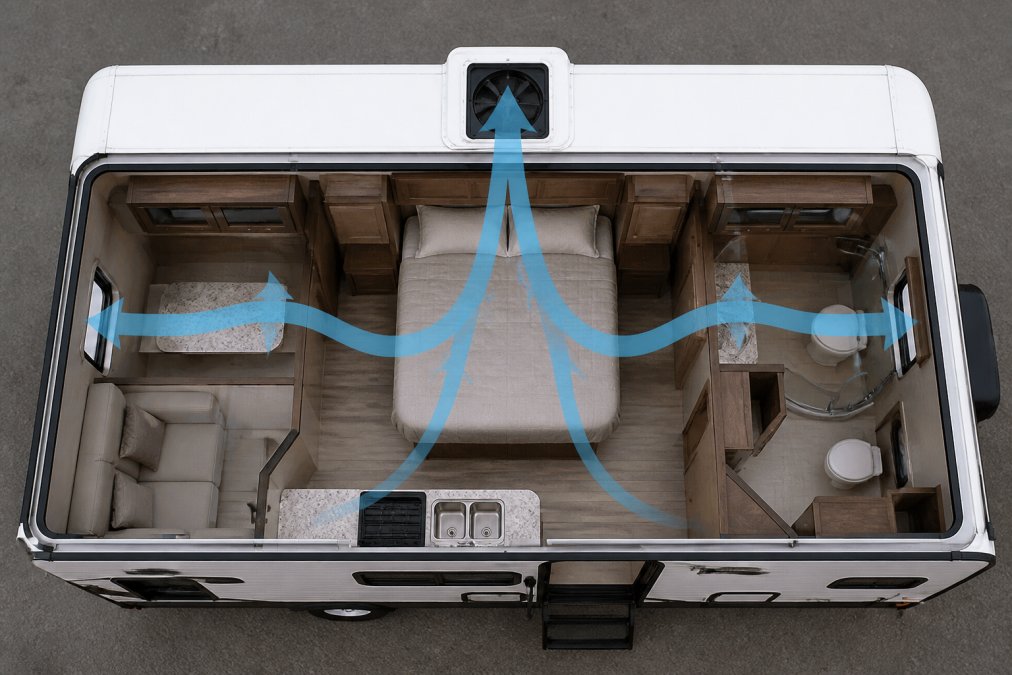
Strategic ventilation: positioning and airflow direction
Most RVs have roof vents and windows, but many owners don’t use them effectively. Hot air rises, so roof vents should be open during warm nights. Windows should be positioned to create cross-ventilation, open windows on opposite sides so breezes flow through the sleeping area.
If your RV has a single roof vent near the sleeping area, open it fully. If you have multiple vents, open the one closest to your bed to pull hot air directly away from the mattress. Some RV owners install portable battery-powered fans (12V or USB-powered) that direct outside air toward the sleeping area during the coolest hours, typically between sunset and midnight in summer. This creates active cooling without running the engine or air conditioning, which matters for fuel economy and noise during overnight stops.
Position your RV so that prevailing evening breezes flow toward (not away from) your sleeping area. In many regions, wind direction shifts in the evening as land cools faster than water or open terrain. Checking local wind patterns before parking can make a 3 to 5 degree difference in sleeping temperature.
Moisture management: the feedback loop
Moisture management includes using breathable bedding materials and ensuring your mattress has adequate air circulation underneath. If your bed platform is solid (no gaps), consider adding a moisture barrier to allow air to flow beneath it.
The materials you sleep on matter as much as the mattress itself. Cotton and bamboo sheets are naturally moisture-wicking and breathable, pulling sweat away from your skin so it evaporates into the air rather than being absorbed by the mattress. Synthetic blends vary widely, polyester-heavy blends trap moisture, while moisture-wicking synthetics (often marketed as “performance” fabrics) can rival natural materials. Lightweight, breathable comforters or sleep sacks designed for warm climates prevent you from overheating under heavy bedding.
Some RV owners place a small dehumidifier near the sleeping area during humid nights, which removes moisture from the air before it can be absorbed by bedding and foam. This is particularly effective in coastal or subtropical regions where nighttime humidity remains high even after sunset. A small dehumidifier running for a few hours can reduce interior humidity, which noticeably reduces the “clammy” feeling around the mattress.
Seasonal adjustments and integrated cooling
Effective cooling is seasonal. During summer, use minimal bedding and prioritize ventilation. During cooler months, you can use heavier blankets and close vents without compromising comfort. This flexibility is one reason why many RV owners prefer modular sleep solutions like mattress toppers and adjustable bedding rather than a single fixed mattress.
The most effective approach combines all three elements: a slatted or raised bed platform (airflow underneath), open roof vents and cross-ventilation (airflow around the mattress), and moisture-wicking bedding (airflow through textiles). If you address only one, say, opening a vent but keeping a solid platform and heavy synthetic bedding, you’ll see partial improvement. Addressing all three creates a system where heat and moisture are continuously removed from the sleeping area rather than accumulating around your body.
Thermo-Adaptive Foam Benefits for Temperature Regulation
Thermo-Adaptive foam represents an evolution beyond standard memory foam and basic gel-infused options. This technology actively regulates temperature by responding to both your body heat and the ambient environment, maintaining a consistent sleep surface temperature regardless of external conditions.
Thermo-Adaptive foam works by using phase-change materials embedded within the foam structure. These materials absorb excess heat when you’re too warm and release stored heat when the environment cools down, creating a self-regulating sleep surface.
Practical Steps to Address Heat Issues in Your RV Mattress
Using a topper on a mattress that’s already too soft or too firm won’t fix underlying support problems. If your mattress sags or feels unstable, a topper is a temporary solution at best. A proper mattress replacement is more effective long-term.
The right solution depends on your specific RV setup, climate, and sleep needs. A weekend camper in a temperate region may find that ventilation and bedding changes are sufficient. A long-haul truck driver in a hot climate needs a more comprehensive approach, starting with a mattress engineered for temperature regulation.
Frequently Asked Questions
Why does memory foam get so hot compared to other mattress types?
Memory foam is made from viscoelastic material that absorbs and retains body heat because of its dense cellular structure. Unlike open-cell foams or spring mattresses that allow air to circulate freely, memory foam traps warmth close to your body. In RVs, this effect intensifies because the enclosed sleeping space has limited ventilation and ambient temperatures can climb quickly in parked vehicles, especially during summer or in sunny locations.
How does a cooling mattress topper for RV help with heat retention?
A cooling mattress topper adds a breathable layer on top of your existing foam, improving airflow and reducing direct contact with the heat-retaining foam beneath. Many toppers use gel-infused materials or open-cell structures that promote heat dissipation and moisture-wicking, pulling sweat away from your skin. This creates a buffer zone that moderates temperature without replacing your mattress entirely, making it an affordable solution for RV dwellers.
What are the main benefits of Thermo-Adaptive foam for RV sleeping?
Thermo-Adaptive foam is engineered to respond to your body’s temperature fluctuations, becoming softer when warm and firmer when cool. This dual-response technology maintains pressure relief while preventing the excessive heat buildup that standard memory foam causes. For RV travelers who experience varying climates and seasonal changes, Thermo-Adaptive foam adjusts automatically, ensuring comfort year-round without the need for seasonal mattress swaps.
Can ventilation and bedding changes really make a difference in RV mattress temperature?
Yes. Improving RV ventilation through roof vents, fans, or slatted bed platforms allows air to circulate under and around your mattress, reducing heat accumulation. Pairing this with moisture-wicking bedding materials and breathable mattress underlays creates a complete thermal management system. Many RV dwellers report noticeably cooler sleep after addressing ventilation and switching to breathable toppers, even without replacing their core mattress.