
Thermo Adaptive Foam Benefits for RV and Truck Sleep

By the Nomad Mattress Sleep Team · Last updated: October 2, 2026
Table of Contents
- What Is Thermo-Adaptive Foam?
- Why Standard Memory Foam Struggles in RVs and Trucks
- How Thermo-Adaptive Foam Works
- Benefits for RV and Truck Sleepers
- Which Nomad Mattresses Use It?
- How to Keep Your Mattress Comfortable and Long-Lasting
- Frequently Asked Questions
What Is Thermo-Adaptive Foam?
Thermo-Adaptive foam is the comfort layer we developed for mattresses that live in RVs, campers and truck cabs, where the temperature can swing from a sun-baked 30°C campsite to a -20°C night in a shut-down cab. Instead of reacting to the air around it, it reacts to your body heat, so the mattress feels consistent whatever the thermometer says.
Why Standard Memory Foam Struggles in RVs and Trucks
Standard memory foam is highly temperature-sensitive. At room temperature it feels soft and contouring, but:
- In the cold, it stiffens. Below freezing, a standard memory foam mattress can feel like a frozen brick, and your body heat may take a long time to soften it, leaving pressure on your hips and shoulders.
- In the heat, it can turn soft and slow, so you sink in and feel stuck when you try to roll over.
- In a vehicle, both extremes are common. An RV or truck cab heats and cools much faster than a house, and there’s no furnace or air conditioning running while you’re parked overnight in many cases.
Read more in The “Frozen Brick” Effect: Surviving Canadian Winters in Your RV or Rig.
How Thermo-Adaptive Foam Works
The key is what we call a heat-reactive rebound rate: the warmer the foam gets, the faster it rebounds.
- The first lie-down: on a cold night, the mattress may feel firmer than it does in summer. That’s normal.
- Your body heat goes to work: the foam under you absorbs your body heat quickly instead of resisting it.
- Within minutes: the area under you becomes supportive and contouring, while the rest of the mattress stays firm. Because warm foam rebounds faster, it doesn’t feel like quicksand when you roll over.
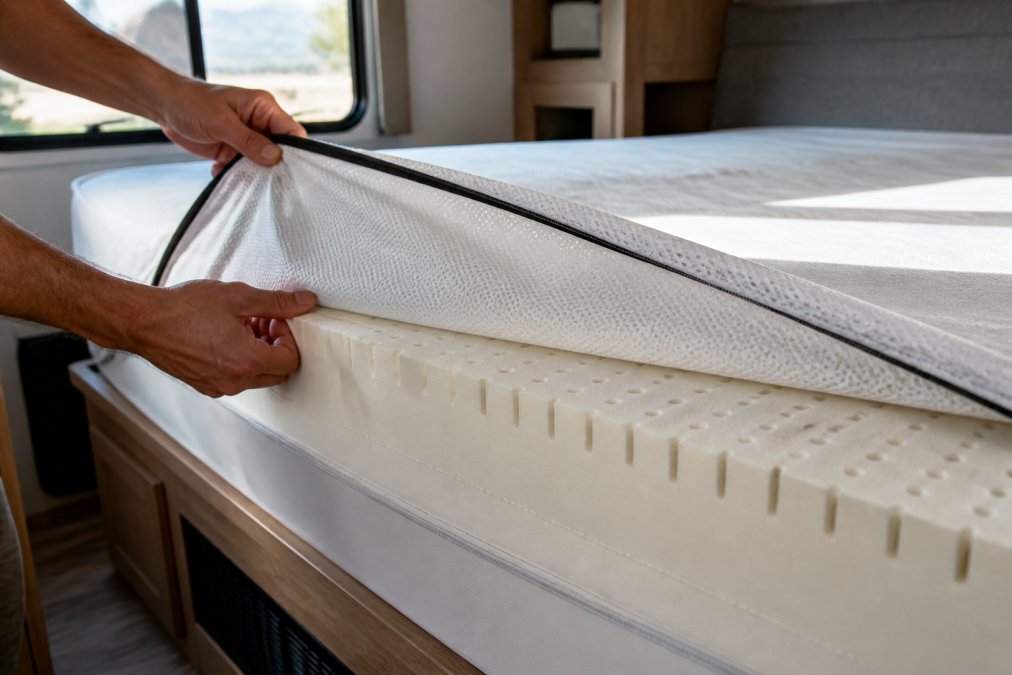
The foam is also ventilated to promote airflow, which helps it sleep cooler in summer than dense standard memory foam.
Benefits for RV and Truck Sleepers
- No long warm-up on cold nights. You don’t lie awake waiting for a frozen mattress to soften.
- Consistent comfort in every season. You don’t need a “summer mattress” and a “winter mattress.”
- Easy to move. Fast rebound means you can change position without feeling stuck.
- Pressure relief for long hauls. The comfort layer contours to your hips and shoulders after a long day of driving.
- Light weight. Foam keeps the mattress light, which matters for payload in an RV or truck.
Which Nomad Mattresses Use It?
| Mattress | Top layer | Best for |
|---|---|---|
| Original Nomad RV (7″) | 2″ Thermo-Adaptive foam | Travel trailers, fifth wheels, truck campers |
| Nomad Truck (7″) | 2″ Thermo-Adaptive foam | Semi-truck sleeper cabs |
| Nomad Hinge (6″) | 1″ Thermo-Adaptive foam | Murphy beds and slide-outs |
| Nomad Slim (6″) | 1″ cooling memory foam | Bunks, pop-ups, van builds |
| Home & Cottage (10″) | 2″ Cool Gel-Flex memory foam | Homes, cottages, roomy motorhomes |
How to Keep Your Mattress Comfortable and Long-Lasting
- Use a breathable, waterproof protector. A plastic-style cover traps heat and moisture against the foam.
- Ventilate underneath. Most RV and truck platforms are solid plywood. A slatted base or breathable underlay lets air move under the mattress and helps prevent mildew.
- Rotate head to foot every 3–6 months, but never flip it. The comfort layer must stay on top.
- Air it out after hot drives by pulling back the bedding for an hour.
- Wash the cover, spot-clean the foam. The zip-off cover is machine washable on a gentle, cold cycle; clean the foam only with a damp cloth and mild detergent.
- Skip thick memory foam toppers. They add a heat-trapping layer over the Thermo-Adaptive foam and cancel out its benefits.
Frequently Asked Questions
What is Thermo-Adaptive foam?
Thermo-Adaptive foam is Nomad Mattress’s heat-reactive comfort foam. It responds to your body heat instead of the air temperature, and it rebounds faster as it warms, so it stays comfortable in hot and cold RVs and truck cabs.
How is Thermo-Adaptive foam different from memory foam?
Standard memory foam stiffens in the cold and softens in the heat, so it can feel rock-hard on a winter night and mushy in summer. Thermo-Adaptive foam softens under your body heat within minutes and rebounds quickly, giving more consistent comfort across seasons.
Will a Thermo-Adaptive mattress freeze in a cold truck or RV?
It may feel firmer when you first lie down on a cold night, but it softens under your body heat within minutes instead of staying hard for hours like standard memory foam.
Which Nomad mattresses have Thermo-Adaptive foam?
The Original Nomad RV and Nomad Truck have a 2-inch Thermo-Adaptive top layer, and the Nomad Hinge has a 1-inch Thermo-Adaptive top layer. The Nomad Slim uses cooling memory foam, and the Home & Cottage uses Cool Gel-Flex memory foam.