
Replace Your RV Mattress With Foam: A Step-by-Step Guide

Table of Contents
- Why Replace Your Stock RV Mattress
- RV Mattress Measuring Guide: Get Your Dimensions Right
- RV Mattress Sizes and Standard Dimensions
- Choosing the Right Foam Type and Density
- RV Mattress Thickness: Finding Your Comfort Sweet Spot
- RV Mattress Expansion Time and Setup Instructions
- Step-by-Step Installation of Your New Foam Mattress
- Ventilation and Moisture Management Under Your New Mattress
- Frequently Asked Questions
Last Updated: October 12, 2026
Why Replace Your Stock RV Mattress
Most RV mattresses are built to cut costs: thin, low-density foam that breaks down within a year or two, leaving a sagging middle, heat buildup, and no back support by morning. This is why many RV owners choose to replace RV mattress foam with a quality alternative from Nomad Mattress.
At Nomad Mattress, we’ve helped hundreds of RV owners and truck drivers make the switch. A quality foam mattress transforms your sleep, and with it your alertness on the road and recovery between drives.
Stock foam is low-density, so it compresses easily and doesn’t bounce back. After a few months of nightly use, it sags and offers almost no support. When you replace RV mattress foam with a higher-density option designed for RVs, you get better support and wake up rested.
RV Mattress Measuring Guide: Get Your Dimensions Right
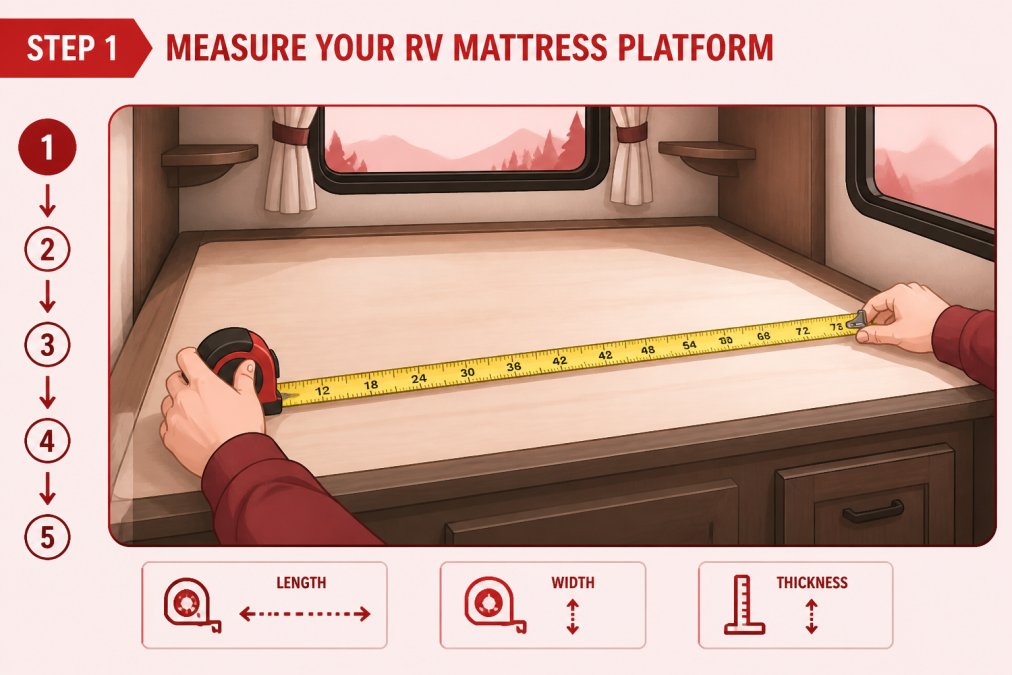
Before you order anything, get exact measurements. Most people guess, then the mattress arrives and doesn’t fit. Nomad Mattress recommends precise measurements to ensure a perfect fit.
Here’s how to measure correctly:
Measure the length of your sleeping platform. Run a tape measure from head end to foot end and write it down.
Measure the width. Measure the platform from side rail to side rail, not the space above it. Some RVs have curved walls, so measure where the mattress will actually sit.
Measure the thickness of your current mattress. This tells you your vertical clearance. With storage underneath or a lifting bed frame, a thicker mattress might block access.
Check for obstructions. Note whether corners are square or rounded, and look for vents, pipes, or fixtures sticking into the sleeping area.
Take a photo. Snap the sleeping area from above and the side as a visual record when comparing options.
Once you have these measurements, you can find a mattress that actually fits. Nomad Mattress offers standard RV sizes that match common camper and truck configurations. If your space has unusual dimensions, email info@nomad-mattress.com with your measurements and a photo.
| Measurement |
|---|
| — |
| Length |
| Width |
| Thickness |
| Why It Matters |
|---|
| Ensures mattress doesn’t hang off the end |
| Prevents gaps on the sides |
| Confirms clearance for storage or lifts |
RV Mattress Sizes and Standard Dimensions
RVs and sleeper cabs come in a handful of standard sleeping configurations. Knowing yours saves time and money when choosing a Nomad Mattress.
Short Queen. The most common RV size, typically around 203 cm long and 152 cm wide.
Full. Approximately 190 cm long and 137 cm wide. Found in larger RVs and some truck sleeper cabs, it’s wider than a short queen, which matters for two sleepers.
Queen. Around 203 cm long and 152 cm wide. It fits larger RVs and some sleeper cab setups, and since it’s the most common home size, bedding is easy to find.
Twin or Single. Approximately 190 cm long and 97 cm wide. If your RV has bunks, you’ll need this size.
Truck Sleeper Cab. These vary by manufacturer. Long-haul trucks often have a sleeping area that’s around 203 cm long and 102 cm wide. Some are narrower. Measure your exact space before ordering.
The key point: don’t assume your RV matches a standard size. Measure it and compare against these dimensions. Nomad Mattress makes replacement mattresses in the most common RV and truck configurations.
Choosing the Right Foam Type and Density
Not all foam is the same. Foam type and density determine how your mattress feels and how long it lasts. Nomad Mattress offers options designed for optimal comfort and durability.
Memory foam versus conventional foam
Memory foam responds to body heat, softening where you lie and supporting the rest of your body for a cradled feel. It’s excellent for pressure relief, especially with back or shoulder issues.
The downside: it retains heat, so you may feel too warm in summer, and it responds slowly when you change positions, which some find restrictive.
Conventional foam (polyurethane) doesn’t respond to heat the same way. It bounces back quickly, so it’s cooler and more responsive, better if you sleep hot or change positions often.
Nomad Mattress uses Thermo-Adaptive foam, which blends both benefits: the pressure relief of memory foam without the heat retention. That matters in an RV, where temperatures swing from day to night.
Foam density and firmness for your body weight
Density is measured in pounds per cubic foot. Higher density means firmer, more durable foam. Nomad Mattress guides you to the right density for your needs.
Low-density foam (under 2 pounds per cubic foot). What comes in most stock RV mattresses: soft, compresses easily, breaks down quickly. Avoid it for a replacement.
Medium-density foam (2-3 pounds per cubic foot). The sweet spot for most sleepers: good support without feeling too firm, longer-lasting than low-density foam, and adaptable to different body weights.
High-density foam (over 3 pounds per cubic foot). Firmer and more durable, ideal for heavier sleepers or anyone wanting a mattress to last 10+ years, and better for side sleepers needing extra support at the hips and shoulders.
Your body weight matters: a lighter person (under 150 pounds) can use medium-density foam comfortably, while a heavier person (over 200 pounds) benefits from high-density foam or a thicker mattress. If you’re unsure, Nomad Mattress has a quiz on our website that pairs you with the right option based on sleep position and body weight.
RV Mattress Thickness: Finding Your Comfort Sweet Spot
Thicker isn’t always better, but it usually is for comfort and durability. Nomad Mattress offers various thicknesses to suit different needs.
4-6 inches. Thin, what you’ll find in most stock RV mattresses. Fine for occasional use but breaks down quickly under regular sleeping.
6-8 inches. A good middle ground: enough cushion for comfort and enough support to last several years. Most RV owners find this works well in tight sleeping spaces.
8-10 inches. Thicker, more comfortable, and longer-lasting. The trade-off is weight and space. If your RV has room and weight limits aren’t a concern, this is excellent.
Over 10 inches. Very thick, more like a home mattress. In a small RV it might be too tall and block access to storage or windows. Check your clearance first.
The right thickness depends on three things: comfort preference, available space, and your RV’s weight capacity. A truck sleeper cab has tight clearance, so 6-8 inches is usually the maximum.
When you measure your current mattress thickness, you’ll know what you’re working with. Want more comfort? Go one size thicker. Want to save weight?
RV Mattress Expansion Time and Setup Instructions
Foam mattresses are often compressed and rolled for shipping. On arrival, they need time to expand and off-gas. Nomad Mattress recommends following these steps for optimal setup.
Unroll it immediately. Don’t leave it in the bag. Cut the plastic and unroll it on your bed platform or the ground nearby; it needs air circulation to expand fully.
Give it 24-48 hours. Most expansion happens in the first 24 hours but can continue for 48. You might notice a slight chemical smell; that’s off-gassing, normal and harmless. Ventilate your RV or living space well.
Don’t compress it while it’s expanding. Using the bed early is fine, but don’t stack anything on top or fold it up. Let it expand naturally.
Check the fit after expansion. It should sit snug against the sides with no gaps. Gaps mean the mattress might shift during sleep.
Most people can sleep on their new mattress after 24 hours, though it softens slightly for a few days. Nomad Mattress mattresses come with a 90-day sleep trial, so you have time to adjust to the feel.
Step-by-Step Installation of Your New Foam Mattress
Installing a new mattress is straightforward, but doing it right prevents problems later. Follow these steps for a smooth installation of your Nomad Mattress.
Removing your old mattress safely
Step 1: Clear the space. Remove all bedding, pillows, and anything else on top. Open windows or vents to get air flowing through the RV.
Step 2: Check what’s underneath. Look at the frame or platform: solid wood? Metal rails? Storage compartments? Knowing the structure helps you remove the old mattress without damage.
Step 3: Lift and remove. If it’s light enough, lift it straight up and out. If it’s heavy or space is tight, tilt it on edge, stand it vertically, then maneuver it out.
Step 5: Dispose of the old mattress responsibly. Old foam mattresses can be recycled or donated; check with local waste management or donation centers.
Positioning and securing your new foam mattress
Step 1: Position the mattress. Place it on the platform and center it so there’s equal space on both sides.
Step 2: Check alignment. Make sure it’s straight and level. If your platform tilts slightly, the mattress follows; that’s normal. The key is that it isn’t bunched up or twisted.
Step 3: Secure it if needed. Most RV mattresses stay put from fit and weight. If your RV bounces a lot on rough roads, use non-slip mats or straps to prevent shifting.
Step 4: Add your bedding. Add sheets, blankets, and pillows. Use fitted sheets designed for your mattress size to keep everything in place.
Step 5: Let it settle. Sleep on it a few nights and observe how it feels; the foam adjusts slightly with use. After a week, you’ll know whether the firmness and support are right.
If the mattress shifts or doesn’t feel right after a few nights, contact Nomad Mattress support. We stand behind our products with a 90-day sleep trial and a 20-year limited warranty.
Ventilation and Moisture Management Under Your New Mattress
Moisture is the enemy of foam mattresses. In an RV, where humidity runs high and air circulation is limited, managing moisture keeps your mattress healthy and prevents mold or mildew. Proper ventilation is crucial for your Nomad Mattress.
Why moisture matters. Foam absorbs water. Trapped moisture under your mattress breaks down the material and creates an environment for mold, especially in damp climates or humid seasons.
Ensure air flow underneath. If your RV platform is solid wood or metal, moisture can get trapped between it and the mattress. Create space for air to circulate by:
- Using thin wooden slats or a raised platform instead of a solid base
- Leaving a small gap between the mattress and the walls
- Opening windows or using a vent fan during humid weather
Monitor humidity inside your RV. Keep levels below 60% if you can.
Wipe down the platform occasionally. If you notice condensation under the mattress, wipe the platform dry. This prevents moisture from accumulating.
Use a mattress protector. A waterproof or moisture-resistant protector sits between the mattress and your sheets, guarding against spills and reducing moisture absorption. Make sure it’s breathable so it doesn’t trap moisture underneath.
Nomad Mattress foam resists moisture better than standard foam, but ventilation still matters. Good air flow under your mattress extends its life and keeps your sleeping surface healthy.
Replacing your stock RV mattress is one of the best investments you can make for your sleep and health on the road. A quality Nomad Mattress can transform your travel experience.
Frequently Asked Questions
What should I measure before replacing an RV mattress?
Measure the length, width, and height of your mattress platform from wall to wall. Check for any sloped ceilings or obstacles like storage compartments. Take photos from multiple angles. Nomad Mattress offers standard RV sizes, but if your space is unusual, email info@nomad-mattress.com with your measurements and photos for guidance.
How long should a new foam mattress expand before use?
Most foam mattresses benefit from 24-48 hours of expansion time after unboxing. During this period, the foam regains its full thickness and density. Avoid sleeping on the mattress or applying heavy weight during the first 24 hours. If you need to use it sooner, allow at least 12 hours of expansion time. Temperature and humidity affect expansion speed, so a slightly longer wait in cooler conditions is normal.
Can I use a standard-size foam mattress in my RV?
Standard mattress sizes often don’t fit RV sleeping areas, which have unique dimensions. RV platforms are typically shorter and narrower than residential beds. Nomad Mattress offers RV-specific standard sizes that fit sleeper cabs, travel trailers, and motorhomes properly. If your RV’s sleeping area is an unusual shape, contact info@nomad-mattress.com with measurements and photos.
What type of foam is best for an RV mattress?
Memory foam and high-density foam are both popular for RVs, each with different benefits. Memory foam provides pressure relief and conforms to your body, while high-density foam offers firmer support and better durability. Nomad Mattress uses Thermo-Adaptive foam that regulates temperature, keeping you comfortable in hot summers and cold winters. Your choice depends on your sleep position, body weight, and whether you prioritize softness or firm support.