
Prevent Overheating in RV Memory Foam: 2026 Guide

Table of Contents
- Why RV Memory Foam Traps Heat and Moisture
- How to Improve Airflow Under an RV Mattress
- Best Cooling Mattress Topper for RV Sleepers
- RV Mattress Moisture Control and Mildew Prevention
- Choosing Bedding Materials That Breathe
- Climate-Specific RV Sleeping Strategies
- Conclusion
- Frequently Asked Questions
Last Updated: September 16, 2026
Why RV Memory Foam Traps Heat and Moisture
Memory foam sleeps hot in an RV because the same properties that make it comfortable—density, conformity, and a closed-cell structure—trap body heat and moisture beneath you. In a stationary bedroom, that heat has somewhere to go; in an RV, it often doesn’t.
How Foam Density and Conforming Properties Affect Body Heat Dissipation
Higher-density memory foam conforms closely to your body, which is why it relieves pressure points, but that same conformity reduces the air gaps where heat would escape. Heat-sensitive foam softens as it warms, sinking you deeper and reducing airflow further.
Why RV Bed Platforms Make Overheating Worse
Most RV beds sit on a solid plywood platform, often with storage underneath and no ventilation. That base blocks the mattress’s bottom surface from releasing heat or moisture, so both go up through the foam.
How to Improve Airflow Under an RV Mattress
The fastest way to improve airflow under an RV mattress is to create a gap between the mattress and platform so air moves across the bottom surface. Three practical routes range from nearly free to a full rebuild.
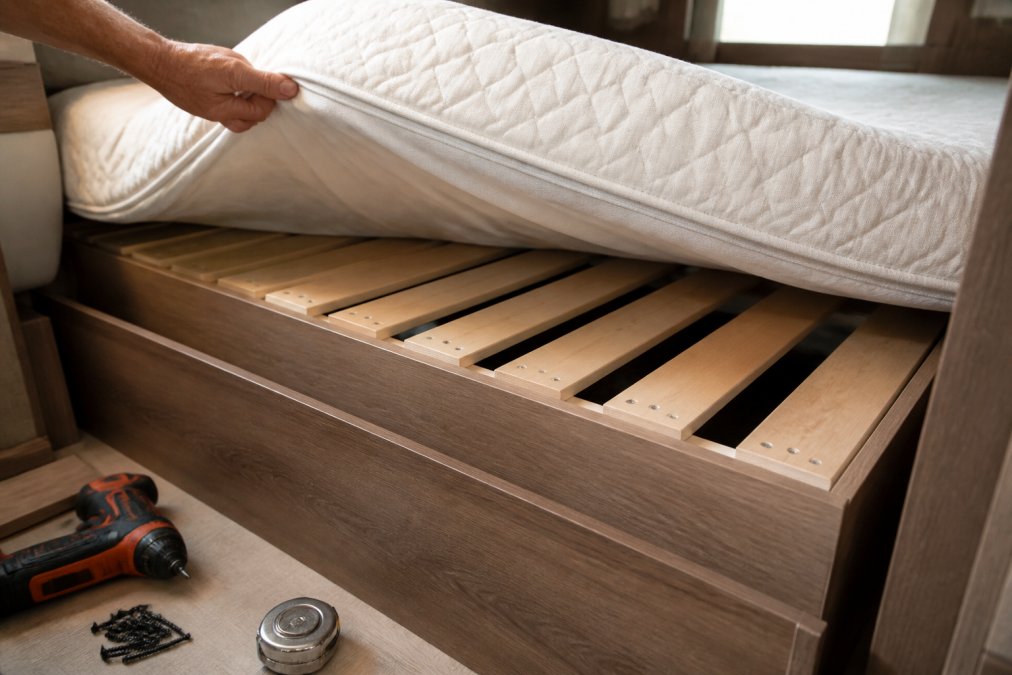
DIY Under-Mattress Ventilation Systems That Work
A simple DIY setup uses interlocking PVC or plastic grid tiles, the kind sold for garage flooring, laid across the platform. The grid raises the mattress 1 to 2 centimetres and creates open air channels. Cut to fit, leave a small gap at the edges, and check every few months for condensation.
|
Solution |
Effort |
Cost Level |
Best For |
|---|---|---|---|
|
Mesh underlay |
Low |
Low |
Quick fix, weekend campers |
|
Drilled platform holes |
Medium |
Low |
Solid platforms with clear space below |
|
Grid tile system |
Medium |
Medium |
Full-time dwellers wanting airflow channels |
|
Slatted base rebuild |
High |
Higher |
Permanent, best long-term ventilation |
Best Cooling Mattress Topper for RV Sleepers
The best cooling mattress topper for an RV is built around phase change material or gel-infused foam rather than plain memory foam, moving heat away instead of storing it. But the spec sheet matters less than how the topper interacts with your platform, bedding, and the RV’s non-standard bed dimensions. Nomad Mattress does not require a topper because it utilizes specialty Adaptive Foam technology.
What Actually Cools: The Three Mechanisms
Cooling toppers work through one or more of these mechanisms; knowing which you’re buying prevents wasted money:
- Phase change material (PCM). Microcapsules in the foam or cover absorb heat at a specific temperature and release it as the surface cools. PCM has finite capacity; once saturated, cooling stops until the capsules reset overnight. Best for sleepers who run hot for the first hour or two, not all night. Nomad’s Thermo-Adaptive Foam offers phase change properties.
- Gel infusion. Gel beads or layers increase thermal conductivity, spreading heat laterally from contact points. Gel doesn’t actively cool; it redistributes, and helps most when paired with airflow underneath since the heat still has to go somewhere. All Nomad Mattresses include gel in the top layer of foam to aid in heat redistribution.
- Graphite and charcoal infusions. These increase conductivity and, in the case of charcoal, help with odor and moisture. They are a supporting layer, not a primary cooling solution. The Nomad Universal Rest Charcoal pillow is a perfect example of this type of infusion.
RV-Specific Sizing and Thickness Trade-Offs
RV beds are rarely standard. Short queen (60 × 75 inches), RV king (72 x 80 inches), and corner-cut shapes are common, and a residential topper will overhang or bunch. Measure the actual sleeping surface, not the mattress label; manufacturers round.
Thickness is a real trade-off:
- 2 centimetres or less. Adds cooling without changing the feel of the mattress much. Best if you already like your mattress’s firmness.
- 3 centimetres. Noticeable pressure relief but can make a firm mattress feel soft and can reduce the effectiveness of an under-mattress ventilation gap by compressing it.
- 4 centimetres or more. Usually a mistake in an RV: it adds weight, raises sleeping height in limited headroom, and defeats the cooling topper’s purpose by adding foam between you and the airflow below.
What to Avoid
- Waterproof membranes on top. A waterproof layer traps heat and condensation against the foam. If you need waterproofing, put it under the fitted sheet as a separate protector, not as the topper’s top surface.
- Toppers with a vinyl or TPU backing. Same problem; vapor cannot pass through.
- Toppers marketed only by ‘cooling fabric.’ A cool-to-the-touch cover feels good for five minutes and does nothing for the heat that builds over an hour.
The Order of Operations
What most shoppers get wrong is buying a topper to fix a mattress that’s fundamentally too hot. A topper can’t compensate for a solid platform and no ventilation. Fix airflow first, then add cooling layers; if the mattress still sleeps hot after an underlay or platform rebuild, a PCM-and-gel topper is the next step.
RV Mattress Moisture Control and Mildew Prevention
Mildew prevention in an RV comes down to stopping condensation before it soaks into the foam. Overnight moisture has to go somewhere, and on a solid platform with no airflow, it goes into the mattress. However, the mattress is only one of several moisture sources.
Where the Moisture Actually Comes From
Most guides blame sweat. In practice, an RV mattress absorbs moisture from at least four sources:
- Respiration and perspiration. An adult releases roughly a cup of water vapor overnight. Two adults in a small cabin push indoor humidity up noticeably by morning.
- Cooking and showering. Steam from a stovetop or a hot shower migrates through the cabin and settles on the coolest surface, often the mattress platform or the underside of the foam.
- Temperature swings. A warm cabin at night and a cold morning outside creates a dew point inside the RV; moisture condenses on any surface below it, including the mattress underside.
- Leaks and road spray. A small window seal or storage compartment leak can wick into the platform and stay there for months before you notice.
The Under-Mattress Inspection Routine
This is the step most RV owners skip, and it is the single most effective mildew prevention habit:
- Lift the mattress once a week during humid or cold-weather camping. Check the foam underside and platform top.
- Feel for dampness, not just visible water. Mildew starts in the slightly-damp stage long before dark spots appear.
- Check corners and edges first. Condensation collects where airflow is weakest.
- Air the mattress for at least an hour with the platform exposed, prop it against a wall or lay it across the bed frame.
- Wipe the platform dry before replacing the mattress. A dry platform cannot feed mildew.
Humidity Targets and Tools
A small hygrometer takes the guesswork out of moisture management. Keep cabin humidity below roughly 50 percent while sleeping; above that, condensation on cool surfaces becomes likely.
- Dehumidifier. The most direct tool, run it while you sleep or for an hour before bed in humid climates.
- Air conditioning. AC removes moisture as well as heat; even a short evening run drops cabin humidity significantly.
- Ventilation. Open a roof vent and a window slightly for cross-flow. Even in cold weather, a few minutes removes accumulated vapor.
- Desiccant packs. Useful in storage or small enclosed spaces under the bed, but they saturate quickly and need regular replacement.
Signs the Foam Has Already Absorbed Moisture
Mildew inside foam is difficult to remove completely. Watch for:
- A musty or earthy smell that returns after airing
- Dark spots or discoloration on the foam surface or seams
- A mattress that feels damp even after a dry day
- Allergic-type symptoms that improve when you sleep elsewhere
A Note on Protectors
A moisture-wicking protector lets vapor pass through; a waterproof protector seals it in. In an RV, choose a breathable protector for dry heat, and a breathable protector plus active dehumidification for humid heat. Never rely on a waterproof protector alone; it traps the problem against the foam.
Choosing Bedding Materials That Breathe
Bedding changes how hot you sleep as much as the mattress does. Synthetic materials like polyester trap heat and block moisture-wicking; natural fibers let both pass through.
Prioritize:
- Cotton or linen sheets for breathability and moisture-wicking
- A light wool or cotton blanket instead of a heavy synthetic duvet
- Fewer bedding layers in summer so body heat can dissipate
Climate-Specific RV Sleeping Strategies
Your strategy should change with the climate you’re parked in. A setup that works in a dry prairie summer will fail in coastal humidity.
Conclusion
Overheating in an RV memory foam mattress is rarely a foam problem alone. It’s a system problem: dense foam, a solid platform, trapped moisture, and heat-holding bedding. Fix the airflow under the mattress, choose moisture-wicking layers, and match your setup to your climate, and most of the problem disappears.
Frequently Asked Questions
Why does my RV memory foam mattress make me hot at night?
Memory foam responds to body heat by softening, which means it holds warmth against your sleeping surface instead of releasing it. In an RV, the problem compounds because most bed platforms are solid wood with no airflow underneath. Heat-sensitive foam can’t dissipate body heat, and the enclosed space traps humidity. The result is a mattress that feels warm when you get in and stays warm all night. Nomad Mattress eliminates this problem by providing top tier quality foam that all heat to be wicked away from the body, keeping you cool all night long.
Can I use a memory foam mattress in my RV without overheating?
Yes, but the setup matters more than the foam itself. Nomad RV 7” Mattress includes ventilation holes to help keep air flow moving to prevent overheating. Add a slatted or ventilated base so air can circulate beneath the mattress, use a breathable mattress protector rather than a waterproof vinyl one, and choose moisture-wicking sheets. If your RV has a solid platform, a simple DIY ventilation grid made from wooden battens can make a noticeable difference in how cool the mattress sleeps.
Do cooling mattress toppers actually work for RVs?
They help, but results vary by material. Gel-infused toppers and those using phase change material absorb and redistribute heat rather than blocking it. The key is pairing the topper with airflow underneath. A cooling topper on a solid RV platform with no ventilation will still trap heat. Look for toppers that mention breathability and thermal conductivity, not just ‘cooling’ on the label. A Nomad Mattress is designed to provide cooling and comfort, so that you do not need to invest in costly mattress toppers.
How does humidity affect RV mattress temperature?
High humidity slows evaporative cooling from your skin, so you feel hotter even at the same temperature. In an RV, moisture also builds up inside the mattress, especially over a solid platform. That trapped moisture reduces airflow through the foam and creates conditions for mildew. Using a moisture barrier under the mattress, ventilating the RV daily, and running a dehumidifier in damp climates all help keep the sleeping surface drier and cooler.