
Mattress Firmness for Lower Back Pain: A How-To Guide
Table of Contents
- Understanding Mattress Firmness and Lower Back Pain
- How Mattress Firmness by Sleep Position Affects Back Support
- Why Too Firm Mattress Back Pain Happens
- Why Too Soft Mattress Back Pain Occurs
- Choosing the Right Firmness: Body Weight and Spinal Alignment
- How Long to Adjust to a New Mattress and Troubleshooting
- Finding Your Ideal Firmness: A Practical Assessment Plan
- Mattress Materials and Their Role in Support
- Frequently Asked Questions
Last Updated: October 9, 2026
Understanding Mattress Firmness and Lower Back Pain
Mattress firmness for lower back pain is how soft or hard your mattress feels, and it directly affects whether your spine stays aligned while you sleep. The right firmness supports your natural curve. Too firm, and pressure builds on your lower back. Too soft, and your spine sags out of alignment. Both create pain.
At Nomad Mattress, we’ve worked with truck drivers and RV dwellers who spend more time in their mattresses than most people do in beds. They taught us that firmness isn’t one-size-fits-all. Your sleep position, body weight, and existing back issues all shape what “right” actually means for you.
The confusion starts because mattress firmness and mattress support are not the same thing. Support is the mattress’s ability to keep your spine neutral. Firmness is how the surface feels to your body. A mattress can feel soft but still provide excellent support through its construction.
The biggest mistake is buying based on firmness alone. Two mattresses with identical firmness ratings can perform completely differently for your lower back because their internal structure varies. Nomad Mattress uses Thermo-Adaptive foam that adapts to your body, so firmness works harder for you.
How Mattress Firmness by Sleep Position Affects Back Support
Your sleeping position determines which parts of your body need the most support. A firmness level perfect for a side sleeper may create pain for a back sleeper. Here’s how position changes the equation.
Side Sleepers
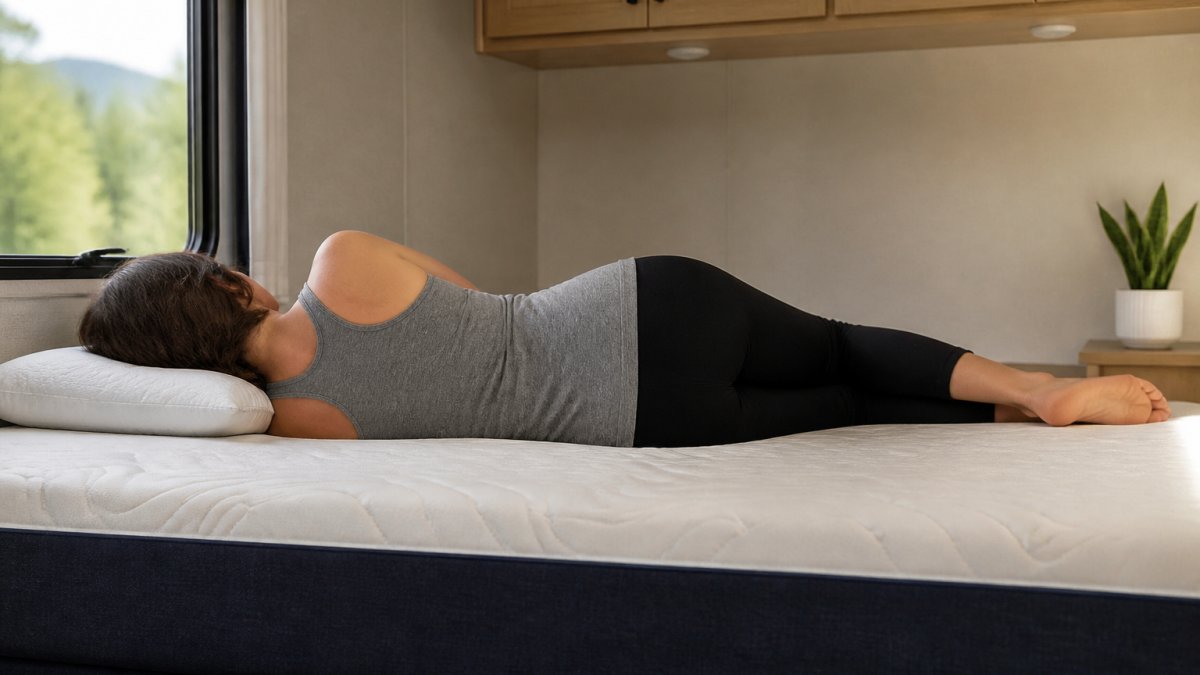
Side sleepers need medium-firm mattresses. When you lie on your side, your shoulder and hip create pressure points. A mattress that’s too firm won’t compress enough, leaving a gap at your waist. Your spine curves sideways instead of staying neutral.
Medium-firm mattresses compress under your heaviest points but still support your lower back’s natural curve. Your spine stays aligned from neck to tailbone. This position is common among people with lower back pain because it reduces pressure on the lumbar spine when the mattress is right.
If you’re a side sleeper with lower back pain, test how the mattress feels at your hip and shoulder. Press down with your hand. The mattress should compress but spring back quickly. If it feels like you’re sinking into a cloud, it’s too soft.
Back Sleepers
Back sleepers often need medium to medium-firm mattresses. When you lie flat on your back, your lower back naturally curves inward slightly. A mattress that’s too soft doesn’t support this curve and lets your lower back sag. A mattress that’s too firm pushes your lower back up, flattening the curve and creating tension.
The ideal mattress for back sleepers supports the curve without forcing it. Your lower back should feel cradled, not pushed. Many people with lower back pain find back sleeping most comfortable because the load distributes evenly across your entire spine.
Test this position by lying on your back and sliding your hand under your lower back. You should feel a small gap, about the thickness of your hand. If the gap is huge, the mattress is too soft. If there’s no gap at all, the mattress is too firm.
Stomach Sleepers
Stomach sleeping creates the most stress on your lower back. Your neck twists, and your lower back arches unnaturally. If you sleep on your stomach and have lower back pain, the mattress firmness won’t fix the position itself. However, a medium-firm to firm mattress prevents your hips from sinking and creating an extreme arch.
Stomach sleepers should consider switching positions if possible. If you must sleep on your stomach, a firmer mattress minimizes additional strain. Place a pillow under your pelvis to reduce the arch in your lower back.
Why Too Firm Mattress Back Pain Happens
A mattress that’s too firm creates pressure points instead of distributing weight evenly. Your body doesn’t sink into the surface enough to allow full contact. Instead, pressure concentrates on your heaviest points: shoulders, hips, and lower back.
When pressure builds on your lower back, the muscles around your spine tense up to protect it. This tension persists even after you get out of bed. Over weeks, this creates chronic pain. Many people assume they need a softer mattress when the real problem is that firmness without proper support causes localized pressure.
Too-firm mattresses also prevent your natural spinal curve from being supported. Your lower back doesn’t get the cradling it needs. Instead, it’s pushed upward, creating tension in the muscles and ligaments. This is especially true for side sleepers, whose bodies need compression to stay aligned.
If you wake up with lower back stiffness that fades within an hour, your mattress is likely too firm. The pain should resolve quickly if it’s mattress-related, not a sign of an underlying condition. Persistent pain that doesn’t improve with position changes or stretching may indicate a medical issue, talk to a healthcare provider.
Why Too Soft Mattress Back Pain Occurs
A mattress that’s too soft lets your body sink too far into the surface. Your heavier sections, hips and shoulders, sink deeper than your lower back. This creates a hammock effect where your spine curves downward instead of staying neutral.
When your spine sags, the discs in your lower back compress unevenly. The muscles and ligaments stretch to compensate. You wake up stiff and sore. Unlike too-firm mattresses, soft mattresses often feel comfortable at first.
Soft mattresses also reduce spinal stability. You may sleep poorly without understanding why. Nomad Mattress customers often report that switching from an old, sagging mattress to a properly supported one improves both pain and sleep quality immediately.
The danger of too-soft mattresses increases with body weight. Heavier people sink deeper, creating a more extreme curve. This is why body weight matters so much in choosing firmness.
Choosing the Right Firmness: Body Weight and Spinal Alignment
Body weight changes how a mattress feels and performs. A medium-firm mattress might feel too soft for a heavier person and too firm for a lighter person.
Lighter body weight (under 68 kg): You sink less into any mattress. Medium or medium-soft firmness often works because you need less compression to achieve proper support.
Average body weight (68-91 kg): Medium-firm is the most common recommendation.
Heavier body weight (over 91 kg): You need firmer mattresses to prevent excessive sinking. A medium-firm mattress might feel too soft.
Spinal alignment depends on how well the mattress supports your body’s natural curves. The goal is a straight line from your head to your heels, your spine’s neutral position.
Test alignment by lying on your side and looking in a mirror (or have someone check). Your spine should form a straight line. Your head shouldn’t tilt down.
How Long to Adjust to a New Mattress and Troubleshooting
Your body needs time to adjust to a new mattress. Most people need 30 to 60 days to fully adapt. During this period, you might feel sore or uncomfortable. This doesn’t always mean the mattress is wrong.
The first week is usually the hardest. Your muscles are used to your old mattress, even if it was causing pain. A new mattress with different support feels unfamiliar. Give it at least two weeks before deciding it’s not working.
Common adjustment issues and fixes:
- Waking up sore: This often means the mattress is too firm or you’re not adjusting yet. Try sleeping in different positions. If soreness persists after four weeks, the firmness may not be right.
- Sleeping too hot: Nomad Mattress uses Thermo-Adaptive foam that regulates temperature, but adjustment takes time. Your body heat patterns change as you adapt. Wait two weeks before concluding it’s a heat issue.
- Feeling like you’re sinking: This suggests the mattress is too soft or you’re not fully settled into it yet. After two weeks, if the sinking feeling hasn’t improved, firmness may be the issue.
- Lower back pain that improves: This is normal. Your muscles are adjusting to proper support. Pain should decrease over four to six weeks.
If pain worsens after four weeks or doesn’t improve at all, the mattress firmness isn’t right for you. Nomad Mattress offers a 90-day sleep trial so you can test whether the mattress works for your back without risk.
The 30-to-60-day adjustment window is real. Most people who return mattresses too early would have loved them after six weeks. Give your new mattress time before deciding.
Finding Your Ideal Firmness: A Practical Assessment Plan
Start by identifying your current pain pattern. Is your lower back pain worse in the morning or at night? Does it improve with movement or get worse?
Step 1: Assess your sleep position
Spend one week noticing your natural sleep position. Most people move during the night, but you likely start and end in one position. Write it down.
Step 2: Determine your body weight category
Categorize yourself as lighter (under 68 kg), average (68-91 kg), or heavier (over 91 kg). This narrows your firmness range immediately.
Step 3: Test firmness in-store or through trial
If possible, lie on mattresses in your firmness range for at least 10 minutes in your sleep position.
Step 4: Monitor your pain for two weeks
Track your lower back pain for two weeks on your new mattress. Rate it on a scale of 1 to 10 each morning.
Step 5: Adjust if needed
If pain worsens or doesn’t improve after four weeks, the firmness likely isn’t right. If pain improves but you’re still uncomfortable, give it a full eight weeks.
Mattress Materials and Their Role in Support
Mattress construction affects how firmness performs. Two mattresses with the same firmness rating can feel and perform differently based on their materials.
Foam mattresses compress evenly and conform to your body. They work well for side sleepers and people with pressure-point pain.
Hybrid mattresses combine foam and springs. Springs provide support and airflow. Foam provides contouring.
Latex mattresses are durable and naturally responsive. They resist sagging and maintain firmness longer than foam. However, they’re heavier and more expensive.
The material also affects how long the mattress lasts. Cheaper foam breaks down in three to five years.
For lower back pain, the material matters less than the firmness and support combination. However, a mattress that sags loses its support benefit.
Choosing the right mattress firmness for lower back pain isn’t guesswork. It’s based on your sleep position, body weight, and how your spine aligns.
Frequently Asked Questions
What mattress firmness is best for lower back pain?
Medium-firm mattresses work well for most people with lower back pain because they balance support and pressure relief. However, the ideal firmness depends on your sleep position, body weight, and personal preference. Side sleepers often prefer slightly softer support, while back sleepers benefit from firmer surfaces. Nomad Mattress offers a quiz on its website to help you find your best match based on these factors. A 90-day sleep trial lets you test the firmness in your own environment before committing.
Can a too firm mattress cause lower back pain?
Yes. A mattress that is too firm creates pressure points at your hips and shoulders, forcing your spine into misalignment. This tension radiates to your lower back, especially for side sleepers. Over time, sleeping on an overly firm surface prevents proper spinal neutrality and can trigger or worsen back pain. If you wake with stiffness or soreness after a few weeks on a new mattress, firmness may be the issue. Nomad Mattress customers can adjust during the trial period to find better balance.
How long should I try a new mattress before deciding if the firmness is right?
Most people need 2-4 weeks to adapt to a new mattress firmness. Your body adjusts to the support level and sleep surface during this period, so initial discomfort often resolves. Track how you feel each morning: reduced stiffness and better sleep quality signal a good fit. If pain persists beyond 4 weeks or worsens, the firmness likely isn’t right for you. Nomad Mattress includes a 90-day sleep trial, giving you plenty of time to assess comfort and support without risk.
Does mattress firmness depend on sleep position?
Absolutely. Side sleepers need softer surfaces to cushion the hips and shoulders while maintaining spinal alignment. Back sleepers typically prefer medium to firm support to prevent sagging at the lumbar region. Stomach sleepers benefit from firmer mattresses to avoid excessive hip sinking. If you share a bed with a partner who sleeps differently, a medium-firm mattress often serves as a compromise. Nomad Mattress offers a range of standard sizes for RVs and Sleeper Cab Trucks in multiple firmness options to match your sleeping style.