
Juno vs Silk and Snow Comparison: Which Mattress Wins?

Table of Contents
- Juno vs Silk and Snow Comparison: Quick Overview
- Construction and Materials: Foam Layers Compared
- Firmness, Feel, and Sleeping Position Suitability
- Motion Isolation, Edge Support, and Temperature Regulation
- Mattress Trial Period Comparison and Warranty Coverage
- Is Juno or Silk and Snow the Best Budget Mattress in Canada?
- Nomad Mattress for Mobile Living: An Alternative Worth Knowing
- Durability, Off-Gassing, and Long-Term Value
- Frequently Asked Questions
Last Updated: September 30, 2026
Juno vs Silk and Snow Comparison: Quick Overview
The Juno vs Silk and Snow comparison comes down to this: both are Canadian foam mattresses built for value, but they solve different problems. Juno is a simple, budget-friendly all-foam build; Silk and Snow is a thicker hybrid with more comfort layers and a plusher feel. This guide breaks down construction, firmness, motion isolation, trial terms, and durability.
Construction and Materials: Foam Layers Compared
Construction determines how a bed feels, how long it lasts, and how well it handles heat. Both brands use all-foam in their core models, but the layer stacks differ in thickness and density.
Juno’s Foam Build
Juno’s core model is a medium-firm all-foam mattress with a support core and comfort layers on top, targeting back and stomach sleepers who want a firmer surface without coils. Don’t assume all-foam means soft, Juno sits on the firmer end, favoring support over sinkage.
Silk and Snow’s Foam Build
Silk and Snow’s flagship is a hybrid combining pocketed coils with high-density foam comfort layers, adding bounce and responsiveness an all-foam build can’t match. The trade-off is weight: coils and thicker foam add kilograms, which matters if you move your mattress often or lift it into tight spaces.
| Feature | Juno (Core Model) | Silk and Snow (Hybrid) |
|---|---|---|
| Build type | All-foam | Hybrid with pocketed coils |
| Firmness | Medium-firm | Medium-plush |
| Feel | Firm, minimal bounce | Responsive, some bounce |
| Weight | Lighter | Heavier |
| Best for | Back and stomach sleepers | Side sleepers, combo sleepers |
Firmness, Feel, and Sleeping Position Suitability
Sleeping position is the biggest factor in mattress choice, but position alone isn’t enough. Body weight changes how far you sink into a given foam density, so two side sleepers of different builds can feel the same mattress very differently. The matrix below combines position with build.
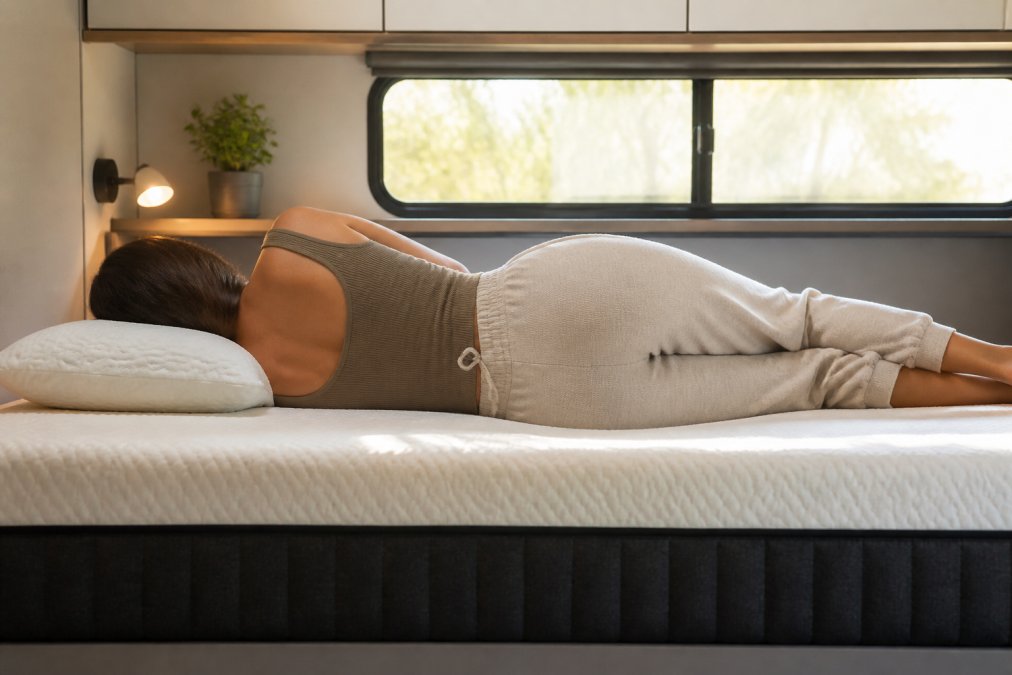
How Each Mattress Feels
Juno’s core model sits around 6.5 to 7 on the standard 1-to-10 firmness scale. Its denser base foam and thinner comfort layers mean you sleep closer to the surface, keeping the spine neutral for back and stomach sleepers without the deep hip sink softer foam produces.
Sleeping Position and Body Type Matrix
| Primary position | Lighter build | Average build | Heavier build |
|---|---|---|---|
| Side | Silk and Snow (pressure relief at shoulder and hip) | Silk and Snow | Silk and Snow, or Juno if you prefer a firmer surface |
| Back | Juno | Juno | Juno, or Silk and Snow if you want more contouring |
| Stomach | Juno | Juno | Juno |
| Combination | Silk and Snow (faster recovery between positions) | Silk and Snow | Either, depending on whether you want bounce or a firmer surface |
Heavier sleepers bottom out softer all-foam comfort layers, so a hybrid’s coil core often holds up better for them over time. Lighter side sleepers under roughly 130 pounds may not compress Juno’s comfort layers enough for pressure relief, and often do better on the plusher hybrid.
Couples and Combination Sleepers
If you and your partner sleep in different positions, the hybrid’s responsiveness usually wins. Combination sleepers change position several times a night, and quick shape recovery makes that easier. Juno’s all-foam surface holds a body impression longer, supportive to some, sticky to others.
If you sleep hot or move around a lot at night, test how quickly a mattress recovers its shape. Hybrids with pocketed coils tend to bounce back faster than all-foam builds, which helps combination sleepers shift positions without feeling stuck.
Firmness Changes Over the First Month
New foam softens as it breaks in, expect a mattress to feel roughly a half-point firmer in the first week than after a month. That matters at the edge of your comfort range: too firm on day one may settle right, while perfect on day one may end up too soft.
Motion Isolation, Edge Support, and Temperature Regulation
Motion isolation and edge support separate a mattress that works for couples from one that doesn’t, while temperature regulation and off-gassing decide whether you sleep through the night. Each comes down to a mechanism in the layer stack, not the cover fabric.
Motion Isolation and Edge Support
All-foam mattresses like Juno absorb motion well because the foam layers deform locally rather than transmitting energy across the surface, that’s what keeps a restless partner’s movement from rippling to your side.
Cooling and Breathability
Temperature regulation matters for anyone sleeping in a vehicle, camper, or room without strong airflow. Foam traps heat as a dense insulator with little internal air movement; coils and breathable covers help heat escape. Silk and Snow’s hybrid moves air through the coil layer, while Juno’s all-foam build relies on the foam itself and can feel warmer in summer.
Don’t judge cooling by the cover alone. A breathable top fabric means little if the foam layers underneath still trap body heat. Ask how the mattress manages airflow through the full stack, not just the surface.
Off-Gassing and Chemical Sensitivity
Off-gassing is the new-mattress smell from foam manufacturing. Most foam mattresses release some odor when unpacked, and in a small, enclosed space like a sleeper cab or camper it lingers longer with less ventilation, air out any new foam mattress in a well-ventilated space first. For chemically sensitive sleepers, look for CertiPUR-US, which limits emissions and restricts certain heavy metals and phthalates in foam.
- Confirm which foam layers carry CertiPUR-US certification
- Ask whether the cover and fire barrier are treated or untreated
- Check whether the mattress uses fiberglass as a fire barrier (some budget foams do)
- Plan a 24- to 72-hour air-out period in a ventilated space before use
- In a vehicle, run ventilation or a fan during the first week
Durability and Sagging Over Time
Durability depends on foam density and support. High-density foam resists sagging better than low-density foam, and on the road, constant vibration and uneven foundations accelerate wear, so a mattress built for mobile use holds up better. Long-term owners commonly report all-foam comfort layers softening noticeably in the first one to two years while coil cores hold their shape longer, the failure point is usually the foam above the coils, not the coils themselves.
Rotate your mattress regularly and use a proper foundation or ventilated base. In mobile setups, moisture trapped under the mattress is one of the fastest ways to shorten its life. A breathable base layer helps more than most owners expect.
Mattress Trial Period Comparison and Warranty Coverage
Trial periods and warranty coverage are where online mattress shopping gets tricky, you can’t lie on a mattress before it arrives, so the return policy is your safety net. Both Juno and Silk and Snow offer sleep trials and warranty coverage, but exact lengths and terms change over time, so check each brand’s site before buying.
A practical way to compare trial periods:
- Confirm the trial length in days, not weeks
- Check whether a break-in period is required before returning
- Confirm who pays return shipping
- Read what voids the warranty (stains, wrong foundation, no proof of purchase)
- Check whether the warranty is prorated or full-term
Is Juno or Silk and Snow the Best Budget Mattress in Canada?
For shoppers hunting the best budget mattress Canada has to offer, Juno usually wins on price-to-simplicity, while Silk and Snow wins on features per dollar. Want a firm, no-frills all-foam bed? Juno. Want a hybrid feel with coils and a plusher surface? Silk and Snow justifies the higher cost.
Nomad Mattress for Mobile Living: An Alternative Worth Knowing
Nomad Mattress makes Canadian-made sleep solutions designed specifically for mobile living: RVs, tractor-trailers, and campers. The core difference is Thermo-Adaptive foam, which regulates temperature across seasons, standard memory foam gets hot and stays hot. Nomad also offers RV-specific sizing and dimensions, including the widest range of sizes for RVs and sleeper cab trucks.
Other features worth noting:
- Lightweight, portable design for easy setup and transport
- Transfer edge support for getting in and out in tight spaces
- Free shipping to most areas across Canada
- A 90-day sleep trial and a 20-year limited warranty
For mobile living, the deciding factor isn’t brand reputation. It’s whether the mattress is sized, weighted, and built for a moving environment. A great bedroom mattress can still be the wrong mattress for a sleeper cab.
Durability, Off-Gassing, and Long-Term Value
Durability and off-gassing are the two long-term questions buyers ask after the first month, and both matter more in a vehicle where airflow is limited and the mattress takes a beating from vibration and temperature swings. Off-gassing is the new-mattress smell from foam manufacturing; in a small, enclosed space like a sleeper cab or camper it lingers longer, so air out any new foam mattress in a well-ventilated space first.
Frequently Asked Questions
Are Juno mattresses any good for side sleepers?
Juno mattresses are generally considered suitable for side sleepers because they provide pressure relief and contouring for shoulders and hips. The medium-firm feel helps keep the spine aligned, which is important for side sleepers. However, personal preference varies, so take advantage of the sleep trial to test it. If you need more support, consider a hybrid design with pocketed coils.
What are the primary differences between Juno and Silk and Snow foam layers?
Juno typically uses a simple foam construction with a support core and comfort layers, while Silk and Snow often incorporates higher-density foam and sometimes a hybrid design with pocketed coils. Silk and Snow may offer more edge support and durability due to its construction. Both use memory foam and high-density foam, but the specific layers affect firmness, cooling, and motion isolation.
Do both Juno and Silk and Snow offer trial periods in Canada?
Yes, both brands offer sleep trials in Canada, though the length and terms may differ. A mattress trial period comparison shows that most Canadian brands provide at least 100 nights. Check each brand’s return policy for details on fees and conditions. Nomad Mattress, for example, offers a 90-day sleep trial on its mobile living mattresses.
Which mattress is better for temperature regulation: Juno or Silk and Snow?
Silk and Snow mattresses often include cooling technology such as gel-infused foam or breathable covers, which can help with temperature regulation. Juno mattresses may sleep warmer because they use traditional memory foam. If you tend to sleep hot, look for mattresses with cooling technology and breathability features. Nomad Mattress uses Thermo-Adaptive foam designed to regulate temperature in mobile environments.