
Is a Cooling Mattress Worth It for Hot Sleepers in an RV?

Last Updated: October 26, 2026
Quick Summary
A cooling mattress is worth it for hot sleepers in an RV because a camper’s small air volume, thin roof and walls, and boxed-in bed trap heat that a house would shed. Look for ventilated foam with microholes, breathable covers, and airflow under the bed.
- RV bedrooms overheat faster because a few hundred cubic feet of cabin air heats quickly and holds that heat.
- Consumer Reports notes innerspring or hybrid models are most often recommended for hot sleepers because foam tends to retain heat.
- Measure the actual sleeping platform, not the old mattress, since RV sizes are not standardized.
- Use a slatted or ventilated bed base instead of a solid board so air can move under the mattress.
- Nomad’s Thermo-Adaptive foam uses microholes for ventilation and adapts to body heat in both warm and cold weather.
Table of Contents
- Why RV Sleepers Overheat More Than Home Sleepers
- What Makes the Best RV Mattress for Hot Sleepers
- RV Mattress Sizes: Measure Before You Buy
- Mattress Ventilation for RVs: The Hidden Heat Trap
- Choosing a Mattress for All-Season RV Use
- Cooling Claims vs. Real Evidence: What to Ignore
- Matching a Cooling Mattress to Your Sleeper Profile
- Find Your Fit with Nomad Mattress
- Frequently Asked Questions
Why RV Sleepers Overheat More Than Home Sleepers
A cooling mattress matters more in an RV than in a house: your bedroom sits inside a metal box with almost no thermal buffer.
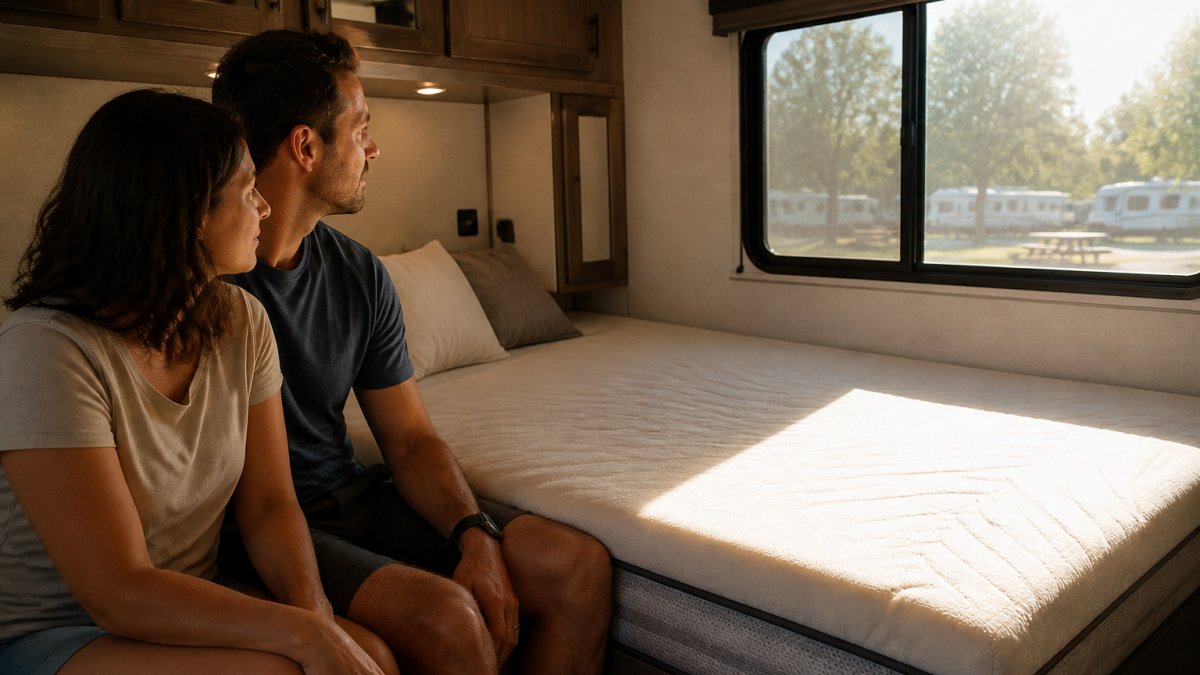
They sleep fine at home and wake up clammy on the road. The problem is rarely the sleeper. It is the environment, and specifically the way heat builds under and around the bed.
Three factors make RV sleepers overheat faster than home sleepers:
- A smaller air volume. A few hundred cubic feet of cabin air heats up quickly and holds that heat.
- A thin roof and walls. There is little between you and the sun, so the ceiling radiates warmth downward for hours after sunset.
- A mattress boxed in on all sides. RV beds often sit tight against walls, which limits airflow across the mattress surface.
The best cooling mattress for hot sleepers in RV settings has to address all three.
What Makes the Best RV Mattress for Hot Sleepers
The best RV mattress for hot sleepers combines breathable materials, airflow through the mattress, and a cover that does not trap heat. Cooling is not a single feature. It is the sum of how a mattress moves heat away from your body and how quickly it lets that heat escape.
Consumer Reports notes that innerspring or hybrid models are most often recommended for hot sleepers because foam tends to retain more heat (Consumer Reports mattress testing(https://www.consumerreports.org/home-garden/mattresses/best-mattresses-of-the-year-a1093119971/)). That is a useful starting point, but it is not the whole story.
Cooling Materials That Actually Move Heat
A cooling mattress is designed to help manage heat. The materials used for this purpose fall into a few categories:
- Gel-infused and carbon-infused foams that spread heat sideways instead of letting it pool under your shoulders and hips.
- Breathable covers with cool-to-the-touch surfaces that feel cooler on contact.
- Ventilated foam with microholes or channels that let warm air escape.
- Pocketed coils that create open space for air to circulate through the core.
Serta points out that strong options for hot sleepers combine a cool-to-the-touch cover with cooling infusions such as gel or carbon fiber, and that there is no single universal best mattress for every hot sleeper (EXTERNAL_LINK: Serta on mattresses for hot sleepers | serta.com). That second point matters. A material that runs cool for one sleeper can feel cold or clammy to another.
Our Thermo-Adaptive foam is designed around that problem. It uses microholes for ventilation and adapts to body heat so the surface feels consistent in both summer heat and cold snaps.
RV Mattress Sizes: Measure Before You Buy
RV mattress sizes are not standardized the way residential sizes are. A “short queen” in one camper can differ by an inch or two from another. Buying by name alone may not be enough.
Common RV Mattress Dimensions
Use these as a starting reference, then verify against your own platform. Dimensions vary by manufacturer and model year, so treat them as a range, not a guarantee.
| Common name | Typical width | Typical length | Notes |
|---|---|---|---|
| RV short queen | 60 in | 74-75 in | Shorter than a residential queen (80 in); common in travel trailers |
| RV queen | 60 in | 80 in | Same footprint as a residential queen |
| RV short king | 72 in | 74-75 in | Wider than a queen but shorter than a residential king |
| RV king | 72-76 in | 80 in | Width varies more than length across brands |
| Bunk / single | 28-30 in | 72-75 in | Often narrower than a twin; check the bunk lip |
| Twin | 38 in | 74-75 in | Common in toy haulers and bunkhouse layouts |
| Full | 53-54 in | 74-75 in | Often found in smaller Class C models |
Two patterns matter more than the exact numbers: RV lengths are frequently shorter than residential equivalents, so a standard residential mattress may not fit lengthwise, and RV king widths vary.
How to Verify Fit Before You Order
Measure the actual sleeping platform, not the old mattress, which can be compressed, swollen, or simply the wrong size for the base.
- Measure length and width at the platform surface, corner to corner
- Measure the height of any platform lip or surround that holds the mattress in place
- Check for rounded corners, wheel wells, slide-outs, or cabinet overhangs that cut into the footprint
- Note ceiling height above the mattress, especially in cab-over and bunk areas
- Confirm door width and hallway clearance for getting the mattress into the bedroom
- Check whether the bed base lifts for storage and how much clearance the hinge needs
Write those numbers down and compare them against the published dimensions of any mattress you consider.
If your space has an unusual shape, email info@nomad-mattress.com with your measurements and a photo, and we will tell you honestly whether a standard size works.
For a step-by-step walkthrough, our guide on how to measure RV mattress dimensions covers the full process, including where to measure and what to record.
Weight and Maneuvering
Size is only half the fit question: a mattress that fits the platform but is too heavy or stiff to bend through the doorway is still wrong. Check the weight against your payload budget and confirm it can be maneuvered into the bedroom. Foam mattresses generally bend more easily than hybrid or innerspring models, which matters in tight hallways and cab-over areas.
Mattress Ventilation for RVs: The Hidden Heat Trap
Mattress ventilation for RVs is one part of sleeping cool, and some airflow considerations are below the mattress rather than on top.
Why Condensation Forms Under an RV Mattress
Cooking, showering, breathing, and wet gear add water vapor to a small air volume, and when warm, humid cabin air meets a cooler surface, it condenses.
Three conditions make it worse:
- A solid platform with no airflow. Moisture has nowhere to escape, so it accumulates in the mattress base.
- A tightly packed under-bed storage bay. Stored items block what little air movement exists and insulate the platform.
- Cool nights after warm days. The temperature swing between daytime cabin heat and overnight cooling drives condensation on surfaces that stay cool.
Practical Fixes That Make a Real Difference
- Use a slatted or ventilated bed base instead of a solid board, so air can move under the mattress
- Leave a gap between stored items and the underside of the platform where possible
- Pull the bedding back each morning so the mattress surface can dry
- Run a small fan or leave a vent open during the day to move air through the cabin
- Check under the mattress monthly for condensation, especially in humid weather and after cold nights
- Dry the mattress surface after spills and before storing the RV for the season
Nomad Mattress’s Thermo-Adaptive foam uses microholes for ventilation.
If your factory RV bed runs hot no matter what you do, our guide on how to make your factory RV bed more comfortable walks through the fixes that address under-bed airflow directly.
Airflow Above the Mattress Matters Too
Under-bed ventilation is one consideration; the other is the air around the mattress surface. RV beds often sit tight against walls on two or three sides, limiting cross-flow across the top.
Choosing a Mattress for All-Season RV Use
A mattress for all-season RV use has to handle both warm and cold conditions. Summer cooling gets all the attention. Then October arrives, and the cabin drops to near freezing overnight.
A mattress that adapts to body heat is designed to maintain a consistent feel across temperature conditions.
That is the design goal behind our Thermo-Adaptive foam. In warm weather the microholes provide ventilation. In cold weather the foam adapts to your body heat so the surface feels consistent.
Weight matters here too. Heavier mattresses add to your payload.
Cooling Claims vs. Real Evidence: What to Ignore
Cooling claims can be hard to verify. “Cooling gel,” “breathable,” and “temperature regulating” are terms used to describe mattresses.
Here is how to separate a real cooling feature from marketing:
| Claim | What It Usually Means | What to Check Instead |
|---|---|---|
| “Cooling gel” | Gel particles mixed into foam | Whether the foam is ventilated and how thick it is |
| “Cool-to-the-touch cover” | A surface that feels cool briefly | Whether the cover stays cool or warms up within minutes |
| “Breathable” | Vague, often unmeasured | Open cell structure, microholes, or coil airflow |
| “Temperature regulating” | Can mean almost anything | Whether the material adapts to body heat |
The honest answer is that cooling performance is hard to measure, and most claims come without test data. Sleep Foundation’s cooling mattress coverage, for example, leans on tester impressions and material descriptions rather than published thermal measurements (Sleep Foundation cooling mattress picks(https://www.sleepfoundation.org/best-mattress/best-cooling-mattress)). That is not a knock on the testing.
Our advice: look at the mattress features and construction.
If you want to understand why some cooling foams feel cold at first and then uncomfortable, our explainer on the frozen brick effect covers what is happening and how to judge whether a mattress will actually stay comfortable.
Matching a Cooling Mattress to Your Sleeper Profile
The right cooling mattress depends on how you sleep, not just how warm you run. Two people in the same camper can have different preferences.
A quick way to match your profile:
- Side sleeper, runs hot: medium-soft feel with ventilated foam and zoned support at the shoulders and hips
- Back sleeper, runs hot: medium firmness with even support and a breathable cover
- Stomach sleeper: firmer surface to keep the spine level, with airflow through the core
- Couple with different preferences: prioritize motion isolation and a middle firmness both can live with
If you sleep on your side, our firmness guide for side sleepers goes deeper on comfort levels and what to look for.
The practical point: cooling is one variable among several.
Find Your Fit with Nomad Mattress
Nomad Mattress builds Canadian-made mattresses for RV owners, truck drivers, and campers. Our Thermo-Adaptive foam uses microholes for ventilation and adapts to body heat.
Every mattress ships free to most areas in Canada, and every purchase includes a 90-day sleep trial and a 20-year limited warranty. We sell standard sizes only, so measure your platform first and email info@nomad-mattress.com with a photo if your space is unusual. Not sure which model suits you? Take the quiz on our site and we will pair you with the right option.
Browse the Nomad RV mattress collection to compare models and find the one that matches your sleeper profile.
Frequently Asked Questions
What mattress materials help hot sleepers stay cool in an RV?
Look for breathable foams with open-cell or perforated structures, gel or carbon-infused foams, and breathable covers. Nomad Mattress uses Thermo-Adaptive foam with microholes for ventilation.
Can a cooling mattress stay comfortable in cold weather?
Yes. Nomad Mattress’s Thermo-Adaptive foam adapts to body heat, and its microholes provide ventilation.
How do you choose the right mattress size for an RV?
Measure your sleeping platform at the corners and at the widest and narrowest points, then compare those numbers to standard RV mattress sizes. Nomad Mattress offers a range of standard sizes. If your space is an unusual shape, email info@nomad-mattress.com with your measurements and a photo for guidance.
How can you improve airflow around an RV mattress?
Use a slatted or ventilated bed platform if your RV has one. Nomad Mattress’s Thermo-Adaptive foam has microholes for ventilation.
Sleeping cool in an RV is a harder problem than it looks, and no single feature solves it. You need the right construction, a ventilated bed base, and a mattress that performs in both heat and cold. Nomad Mattress builds for exactly that combination, with Thermo-Adaptive foam, lightweight construction, and RV-specific standard sizing backed by a 90-day sleep trial and a 20-year limited warranty. Get started with Nomad Mattress and stop losing sleep to a bed that runs hot.
