
How to Sanitize RV Mattress Foam: A Step-by-Step Guide

Last Updated: October 23, 2026
Quick Summary
To sanitize RV mattress foam, vacuum both sides first, then spot-clean with a mild soap or diluted vinegar solution sprayed onto a cloth rather than the foam, and dry it completely with cross-airflow from two fans before making the bed. Always patch-test any cleaner and skip bleach, which breaks down foam.
- Cleaning always comes first, sanitizing comes second, and disinfecting is rarely worth the risk on foam.
- Sprinkle baking soda in a thin layer, let it sit several hours or overnight, then vacuum it up to remove odor.
- Raise the mattress off the platform and aim two fans across the top and underside, not at one spot.
- A lightly misted surface with good cross-airflow usually dries in a few hours; a full-surface clean needs a full day or more.
- Replace rather than sanitize when musty smell returns within days or foam stays damp in the center after drying.
Table of Contents
- What Sanitizing Really Means for RV Mattress Foam
- What You’ll Need Before You Start
- Step 1: Vacuum Loose Dust and Debris
- Step 2: How to Clean an RV Mattress Surface and Stains
- Step 3: How to Remove Odor from Foam Mattress
- Step 4: How to Dry a Foam Mattress in an RV
- RV Mattress Cleaning Products: What’s Foam-Safe
- When to Replace Instead of Sanitize
- Frequently Asked Questions
What Sanitizing Really Means for RV Mattress Foam
To sanitize RV mattress foam means reducing bacteria, dust mites, and allergens on and inside the foam without soaking it.
Foam acts like a sponge, so anything you spray into it has to come back out.
At Nomad Mattress, we build our camping foam with antimicrobial protection because we know how hard it is to keep a mattress fresh in a moving, sometimes damp space.
Every Nomad mattress also includes a zip-off, washable cover, one of its standout features. To clean it, unzip and remove the cover, wash it on a delicate cycle, then either tumble dry on low or hang it to dry.
Sanitizing vs. Cleaning vs. Disinfecting
Sanitizing lowers the number of germs on a surface to a level public health guidance considers safe. Cleaning removes visible dirt, dust, and oils. Disinfecting kills nearly all germs, usually with a chemical that stays wet for a set contact time.
For foam, cleaning always comes first. Sanitizing comes second, and only with a product that will not break down the foam. Disinfecting is rarely worth the risk on a mattress you sleep on every night.
What You’ll Need Before You Start
Gather your supplies before you touch the mattress. Half the damage happens when people improvise mid-job.
- Vacuum with an upholstery attachment
- Mild soap or a few drops of dishwashing liquid
- Spray bottle
One rule before you start: check the manufacturer care label. If it gives specific instructions, those win over anything in this guide.
Remove and Wash the Cover First
Every Nomad mattress has a zip-off, washable cover, one of its biggest selling points since most RV mattresses do not let you take the cover off and wash it separately. Unzip and remove the cover before you start on the foam underneath, then wash it on a delicate cycle and either tumble dry on low or hang it to dry.
Step 1: Vacuum Loose Dust and Debris
Vacuuming is the step people skip, and it does the most quiet work. Dust, crumbs, pet hair, and skin cells work into the foam; vacuuming removes food for dust mites before you add any liquid.
Work slowly across the whole surface with the upholstery attachment, paying attention to seams and edges where debris collects. Flip the mattress or pull the foam insert if you can, and vacuum both sides.
Vacuum first thing in the morning and leave the mattress bare for an hour. Any surface moisture from the night gets a head start on drying before you add anything else.
Step 2: How to Clean an RV Mattress Surface and Stains
Surface cleaning is where most RV owners go wrong: they spray too much, scrub too hard, and soak the foam.
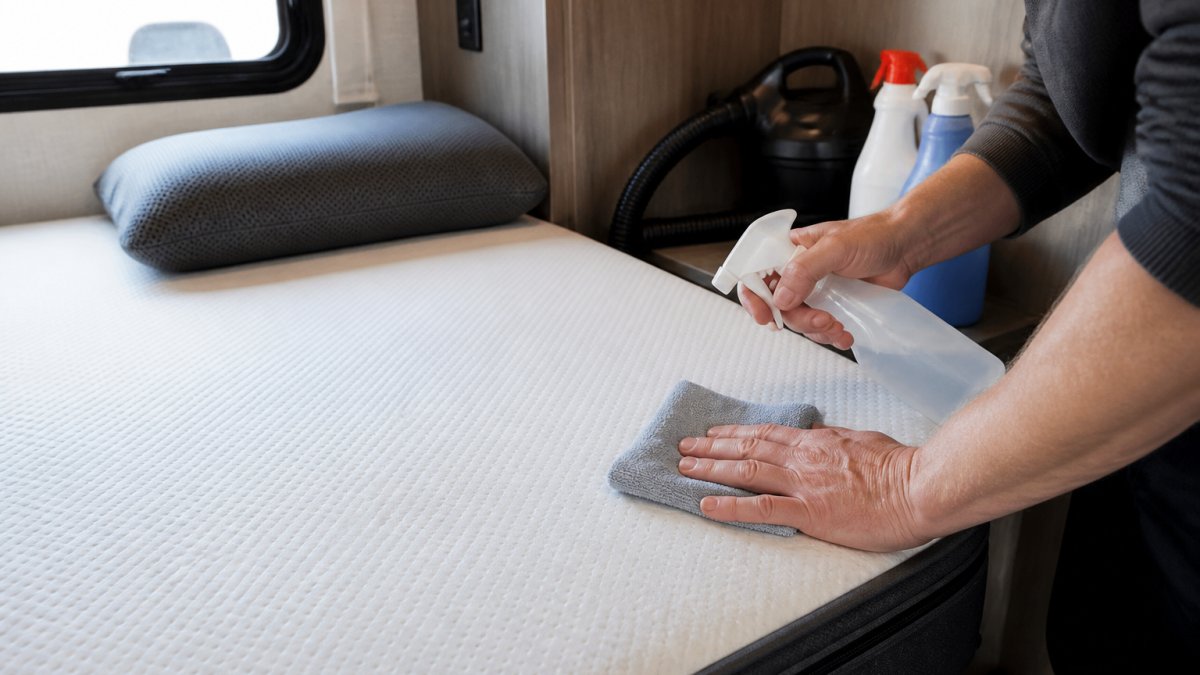
Start with a mild solution: a few drops of dishwashing liquid in a spray bottle of warm water handles most marks.
For the full routine on covers, surface care, and long-term upkeep, our guide on how to care for your mattress walks through it in more depth.
Spot-Cleaning Foam Without Soaking It
The rule for spot cleaning is simple: dab, do not pour.
- Spray the cleaning solution onto your cloth, not the mattress
- Blot the stain from the outside in so it does not spread
- Rinse by blotting with a cloth dampened with plain water
Scrubbing in circles pushes the stain deeper and roughens the foam. Press and lift instead.
Treating Urine and Organic Stains
Urine, sweat, and spilled drinks need an enzyme cleaner, which breaks down the organic matter causing the stain and smell rather than masking it. Blot up as much liquid as you can, apply a small amount of enzyme cleaner per the label, let it sit for the stated contact time, then blot again with a clean cloth. Do not rinse with a soaking-wet cloth, you will just add water back into the foam.
Every Nomad Mattress Has a Zip-Off, Washable Cover
If the stain or smell is on the cover rather than the foam itself, you do not need to spot-clean at all. Every Nomad mattress ships with a zip-off cover, one of its biggest advantages over mattresses with a sewn-in cover: unzip it, remove it, and wash it on a delicate cycle. Tumble dry on low or hang it to dry, then zip it back on once it is completely dry.
Step 3: How to Remove Odor from Foam Mattress
Baking soda is the workhorse here: it absorbs odor rather than covering it up. Sprinkle a thin, even layer over the dry foam, let it sit several hours (or overnight if the RV is empty), then vacuum it up with the upholstery attachment.
If odor keeps coming back, the source may be deeper than the surface. Our charcoal-infused Nomad Universal Rest Pillow is machine washable and neutralizes odors, which makes it a practical companion for anyone fighting smells in a small cabin.
Never seal a damp mattress under bedding or a mattress protector. Trapped moisture is how mold and mildew get started, and once mildew settles into foam, the smell is very hard to remove.
Step 4: How to Dry a Foam Mattress in an RV
Drying decides whether your cleaning worked or made things worse. Damp foam grows mold, and mold means allergens and odor you cannot wipe away. In a camper, “dry it thoroughly” is not enough, the same confined space that traps heat also traps moisture.
Why Foam Dries So Slowly in a Camper
Open-cell foam, including the polyurethane and memory foam in most RV mattresses, holds water in millions of tiny pockets, and air has to move through those pockets to carry moisture away. In a house, room volume and HVAC circulation do that work. In an RV, you have a small air volume, a mattress close to a subfloor, and often bedding on top; condensation forms overnight and a damp subfloor wicks moisture back up.
A Measurable Drying Protocol
Set up airflow before you start cleaning, not after. Then work through these checks in order.
- Raise the mattress off the platform. Prop it on its side or edge so air reaches the underside; lift the foam insert out of the cover if you can.
- Unzip and remove the cover. Every Nomad mattress has a zip-off, washable cover, one of its biggest selling points. Wash it on a delicate cycle, then either tumble dry on low or hang it to dry.
- Move air across, not at, the surface. Two fans pointed across the face of the foam beat one fan blasting a single spot, aim one along the top and one along the underside.
- Open the envelope. Open windows and roof vents on a dry, low-humidity day, and run the roof vent fan to pull moist air out.
- Run the air conditioner on humid days. An RV AC dehumidifies as it cools; on a muggy day, closed windows plus AC removes more moisture than open windows alone.
- Flip or rotate partway through. After a few hours, turn the foam so the underside gets direct airflow.
- Check for residual moisture before making the bed. Press your palm flat and hold for a slow count of ten. Coolness or dampness means more time. Check seams, corners, and the center, not just the top face.
How Long It Actually Takes
A lightly misted surface with good cross-airflow usually dries in a few hours, and a properly blotted spot should be dry to the touch before bedding goes back on. A full-surface clean, or any job on a humid day, needs a full day or more. If the foam still feels cool after a full day of airflow, do not make the bed, trapped moisture under a protector or sheets is how mildew gets its start.
Never seal a damp mattress under bedding or a mattress protector. If you can feel any coolness or dampness under your palm after the drying window, give it another session with the fans before you make the bed.
What Antimicrobial Foam Does and Does Not Do
Nomad Mattress camping foam is built with antimicrobial protection, which lowers the base level of germ and odor-causing growth between cleanings. That protection is a head start, not a substitute for drying, even antimicrobial foam will grow mildew if it stays wet, so the drying protocol above still applies.
Why does foam hold moisture so long? Our explainer on why memory foam mattresses get hot covers how foam traps heat and moisture, and what actually helps.
The Zip-Off, Washable Cover
Every Nomad Mattress camping mattress comes with a zip-off cover you can wash separately from the foam, which is one of the biggest selling points: you get to clean fabric instead of trying to get foam fully dry. To clean it, unzip and remove the cover, wash it on a delicate cycle, then either tumble dry on low or hang it to dry.
RV Mattress Cleaning Products: What’s Foam-Safe
Not every cleaner belongs near foam. The safe list is shorter than the cleaning aisle suggests.
| Product | Safe for foam? | Best for | Watch out for |
|---|---|---|---|
| Mild soap or dishwashing liquid | Yes, diluted | General surface cleaning | Too much soap leaves residue |
| Baking soda | Yes, dry | Odor removal | Must be vacuumed out fully |
| Enzyme cleaner | Yes, small amounts | Urine and organic stains | Follow label contact time |
| Diluted white vinegar | Yes, light spray | Surface refresh | Strong smell until dry |
| Hydrogen peroxide (diluted) | Patch-test first | Tough stains | Can lighten fabrics |
| Isopropyl alcohol | Yes, spot dabs | Greasy marks | Flammable, use with airflow |
| Bleach or harsh solvents | No | Nothing on foam | Breaks down foam, harmful fumes |
The safest way to sanitize RV mattress foam is a foam-safe cleaner you have patch-tested. Skip anything that leaves the surface wet for long, and skip bleach entirely. Nomad Mattress foams are built with antimicrobial protection, which lowers the base level of germ growth between cleanings, not a replacement for cleaning, but a better starting point.
When to Replace Instead of Sanitize
Some mattresses are past saving, and no amount of baking soda fixes them. Knowing when to stop is part of good care. A musty smell is a symptom; the question is whether the source is on the surface or inside the foam.
Surface Problem vs. Core Problem
Start by separating the two: a surface problem responds to cleaning and stays gone, while a core problem comes back.
- Surface problem: the odor fades after vacuuming and baking soda and does not return within a week. Stains sit on the top layer and blot up. The foam feels firm and springs back.
- Core problem: the musty smell returns within days of cleaning. Stains have soaked through to the underside. The foam feels damp in the middle even after a full drying session. The surface crumbles or pills when you rub it.
If you see core-problem signs, more cleaning will not fix it, you are cleaning the surface of a mattress whose interior is the source.
The Signs That Mean Replace
Replace rather than sanitize when you notice:
- Dark patches or a musty smell that returns within days of a full clean and dry
- Foam that stays damp no matter how long you dry it, especially in the center or underside
- Visible mold or mildew spots that spread after cleaning
A Simple Decision Test
If you are unsure, clean and dry one section fully using the steps above, then wait a week with the mattress bare and well ventilated. If odor or dampness returns to that section, the contamination is in the core and replacement is the practical answer. If it stays fresh, the rest of the mattress will likely respond to the same treatment.
What to Check Before You Buy a Replacement
A standard-size replacement is simpler than most people expect. Nomad Mattress sells standard sizes only, so measure your sleeping area first.
Nomad Mattress is made in Canada, ships free to most areas in Canada, and every mattress comes with a 90-day sleep trial and a 20-year limited warranty.
Every Nomad Mattress also has a zip-off, washable cover, which is a major selling point since it makes routine cleaning simple. Unzip and remove the cover, wash it on a delicate cycle, then either tumble dry on low or hang it to dry.
If you are unsure whether yours is beyond saving, our guide on when to replace your trailer mattress lists the signs to check.
Frequently Asked Questions
Can you use disinfectant spray on RV mattress foam?
Only if the label says it’s safe for foam and you apply it lightly. Many household disinfectant sprays contain solvents that break down foam or leave residue against your skin. Spray a fine mist onto a cloth and wipe the surface rather than soaking the foam, then let it air dry completely. For routine freshening, a diluted white vinegar solution or a baking soda sprinkle is gentler on foam and still helps reduce odors and surface bacteria.
How long does RV mattress foam take to dry after cleaning?
Most surface-cleaned foam dries in 4 to 8 hours with good airflow, but humidity and how much moisture you used matter. Open windows, run a fan, and prop the mattress on its side if you can. Avoid putting bedding back on until the foam feels completely dry to the touch. In damp weather, a small dehumidifier speeds things up. Never seal a damp mattress under a cover, because trapped moisture is what leads to mold and mildew.
How often should you clean an RV mattress?
Vacuum the surface every few weeks and spot-clean stains as they happen. A deeper clean, including odor treatment and a full air-out, is worth doing every three to six months, or sooner after spills, illness, or a humid stretch of travel. If you use a washable mattress protector, you can stretch the deeper cleans out. Regular maintenance keeps allergens and dust mites down and helps your foam last longer.
Can baking soda freshen a foam mattress?
Yes. Sprinkle a thin layer of baking soda over the dry foam, let it sit for a few hours to absorb odors and moisture, then vacuum it off thoroughly. It’s a low-risk way to handle lingering smells without adding liquid. For tougher odors, pair it with an enzyme cleaner on the stain itself. Baking soda won’t disinfect, so use it alongside cleaning rather than as a replacement.
