
How to Measure RV Mattress Dimensions: 2026 Guide

By the Nomad Mattress Sleep Team · Last updated: October 2, 2026
Table of Contents
- Why Accurate RV Mattress Dimensions Matter
- Tools You Need Before You Start Measuring
- How to Measure Your RV Bed Platform Step by Step
- RV Mattress Size Chart: Matching Your Measurements
- How to Handle Rounded Corners and Tapered Platforms
- Weight, Ventilation, and Clearance: What Most Guides Miss
- Common Mistakes When Measuring RV Mattress Dimensions
- Frequently Asked Questions
Why Accurate RV Mattress Dimensions Matter
RV mattress dimensions rarely match standard residential sizes, and a mattress that’s off by even an inch or two will slide, bunch, or hang over the edge. At Nomad Mattress, we’ve seen too many buyers order a “queen” only to find it wedges against a slide-out or overhangs the bed frame.
The problem is the word “queen” itself. A standard Queen measures 60″ × 80″ (152 × 203 cm). A Short Queen, the most common size in travel trailers, measures 60″ × 75″ (152 × 191 cm). That 5-inch difference decides whether your mattress fits and whether your sheets stay on.
Below, we’ll show you exactly how to measure your RV bed platform so you order once and get it right.
Tools You Need Before You Start Measuring
You need a tape measure, a helper, and a notepad. Here’s the full list:
- Tape measure (at least 3 m / 10 ft), long enough for RV King and Olympic Queen platforms
- Notepad and pencil to write down every number, in both inches and centimetres if your tape shows both
- A helper to hold the other end of the tape
- Flashlight for dim bunk areas and corners
- Phone camera to photograph the platform and any odd corners, which helps if you want us to check your fit
How to Measure Your RV Bed Platform Step by Step
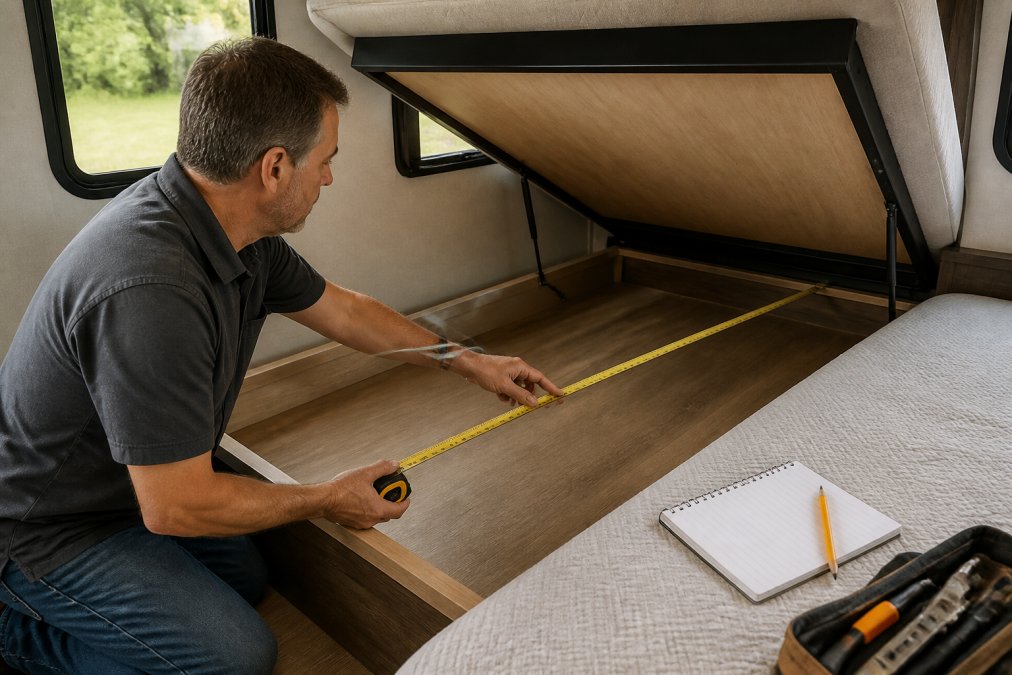
Measuring an RV bed platform takes about 10 minutes: length and width, corners, then height and clearance.
Step 1: Measure the Length and Width
Remove the old mattress. Run the tape from the head of the platform to the foot at three points: the left edge, the centre, and the right edge. Write down all three, then use the smallest number.
Do the same across the width at the head, middle, and foot. Many RV platforms narrow slightly toward the foot, especially in slide-outs. Use the narrowest width.
Measure at the platform surface, not the frame rail or the wall above it.
Step 2: Check the Corners
Look at each corner. If a corner curves instead of meeting at a sharp 90 degrees, or the platform has a notch for a wheel well or cabinet, take a photo and note roughly how far the curve or notch cuts in.
Step 3: Measure Height and Clearance
Measure from the platform up to the lowest thing above it: a cabinet, window frame, or the ceiling. If your bed lifts for storage or sits in a slide-out, close the slide or lower the bed and check the clearance there too. This tells you the thickest mattress your rig can take.
RV Mattress Size Chart: Matching Your Measurements
Use this chart to match your numbers to a standard RV size. If your platform falls between two sizes, size down rather than up: a mattress that’s slightly small sits flat, while one that’s slightly large rides up on the frame.
| RV size | Inches | Centimetres | Common use | Nomad models |
|---|---|---|---|---|
| Twin | 38″ × 75″ | 97 × 191 cm | Bunk beds, small campers | Slim |
| Three-Quarter | 48″ × 75″ | 122 × 191 cm | Older campers, narrow beds | Original |
| Double | 54″ × 75″ | 137 × 191 cm | Couples in smaller rigs | Original, Slim |
| Short Queen | 60″ × 75″ | 152 × 191 cm | Most travel trailers | Original, Slim, Hinge |
| Queen | 60″ × 80″ | 152 × 203 cm | Fifth wheels, larger trailers | Original, Slim, Hinge |
| Olympic Queen | 66″ × 80″ | 168 × 203 cm | Wide-bed fifth wheels and motorhomes | Original |
| Short RV King | 72″ × 75″ | 183 × 191 cm | Short king platforms, slide-outs | Original, Slim |
| Narrow RV King | 70″ × 80″ | 178 × 203 cm | Slide-out king beds | Original, Slim |
| RV King | 72″ × 80″ | 183 × 203 cm | Full-size king platforms | Original, Slim |
See every model and size on our Mattress Sizes page, or compare the Original Nomad RV (7″, medium-firm), the Nomad Slim (6″, firm, more headroom) and the Nomad Hinge (6″, folds for Murphy beds and slide-outs).
How to Handle Rounded Corners and Tapered Platforms
Nomad mattresses are made in the standard rectangular RV sizes above; we don’t make custom shapes. Here’s how to choose a size if your platform isn’t a perfect rectangle:
- Rounded corners: measure length and width along the straight edges, between the points where each curve begins, and choose the standard size that matches.
- Tapered foot end: size to the narrowest width you measured, not the widest.
- Notches or cut-outs for wheel wells, cabinets, or heater ducts: note how far they cut into the platform and send us a photo before you order.
Not sure which size fits? Email customercare@nomad-mattress.com with your length, width, height clearance, and a photo of the platform, and our team will help you choose.
Weight, Ventilation, and Clearance: What Most Guides Miss
Three details separate a mattress that lasts from one that causes problems in its first season:
- Clearance: match the mattress height to the space above your bed. The Original Nomad RV is 7″ thick; the Slim and Hinge are 6″ for bunks, wall beds, and slide-outs where every inch counts; the Home & Cottage is 10″ for roomier motorhomes and fifth wheels.
- Weight: a heavy residential mattress is hard to lift for under-bed storage and adds to your rig’s load. Nomad mattresses are built light enough to carry into a camper and lift on a storage bed.
- Ventilation: most RV beds are solid plywood, which traps moisture under a mattress. Use a slatted base or a breathable underlay, and air the mattress out between trips to prevent mildew.
Common Mistakes When Measuring RV Mattress Dimensions
- Measuring the old mattress instead of the platform. Worn foam spreads and reads wider than the actual space.
- Measuring only one spot. Platforms taper, so a single measurement misses the narrowest point.
- Assuming “queen” means 60″ × 80″. Many trailers use a Short Queen (60″ × 75″).
- Ignoring height and clearance. A thick mattress can block a slide-out or a wall bed.
Frequently Asked Questions
How do I know what size my RV mattress is?
Measure the bare bed platform’s length and width in inches, then compare your numbers to an RV size chart. Common RV sizes are Short Queen (60″ × 75″), Queen (60″ × 80″), and RV King (72″ × 80″). Nomad Mattress makes RV mattresses in nine RV sizes: Twin, Three-Quarter, Double, Short Queen, Queen, Olympic Queen, Short RV King, Narrow RV King, and RV King.
What is the difference between a standard queen and a short RV queen?
A standard Queen measures 60″ × 80″ (152 × 203 cm), while a Short Queen measures 60″ × 75″ (152 × 191 cm). The Short Queen is 5 inches shorter so it fits the tighter bedrooms in most travel trailers. If your platform is about 75 inches long, choose a Short Queen.
What should I do if my RV bed has rounded corners?
Measure length and width along the straight edges between the curves and choose the standard size that matches. Nomad mattresses come in standard rectangular RV sizes, so if your corners are deeply rounded or notched, email a photo and your measurements to customercare@nomad-mattress.com before ordering.
How thick should an RV mattress be?
It depends on the clearance above your bed. A 7-inch mattress like the Original Nomad RV suits most travel trailers and fifth wheels. Choose a 6-inch mattress like the Nomad Slim or Nomad Hinge for bunks, wall beds, and slide-outs with limited headroom.
Do you offer custom RV mattress sizes?
Not currently. Nomad Mattress makes standard RV, truck, and home sizes, all made in Canada. If you need a size we don’t list, contact us; customer requests help shape what we make next.
Measuring an RV bed platform is a 10-minute job that saves you a return and a week of bad sleep. Get the length, width, corners, and clearance right, and the rest falls into place. Nomad Mattress makes Canadian-made RV mattresses in nine RV sizes, with free shipping to most areas in Canada and up to a 90-night sleep trial.