
How to Choose the Best Mattress for Long Haul Truckers

Last Updated: October 25, 2026
Quick Summary
The best mattress for long haul truckers is a medium-firm multi-layer foam mattress that fits your sleeper bunk exactly, regulates heat, and holds a firm edge. Measure your bunk’s usable interior at its smallest points before ordering, since sleeper berths run narrower than home sizes. Foam beats hybrid and innerspring in a cab because it is lighter, quieter, and isolates motion.
- Standard sleeper cab mattresses come in widths of 32, 36, 39 and 42 inches, all approximately 80 inches long.
- Measure length and width at three points each and use the smallest number you record.
- A mattress with a profile of around 7 inches preserves headroom for sitting up and dressing in the bunk.
- Multi-layer foam is the lightest, quietest option and isolates motion better than coils.
- Nomad Mattress includes a 90-night trial and up to a 20-year limited warranty.
Table of Contents
- Why Sleep Quality Decides Your Week on the Road
- Semi-Truck Mattress Sizes: Matching Your Sleeper Berth
- Truck Mattress Materials: Foam, Hybrid and Innerspring Compared
- What Makes the Best Mattress for a Sleeper Cab
- Matching Firmness and Support to Your Body Type and Sleeping Position
- Durability, Cleaning and Moisture Control for Life on the Road
- Weighing Cost, Warranty and Replacement Logistics
- Take the Nomad Mattress Comfort Quiz Before Your Next Run
- Frequently Asked Questions
Why Sleep Quality Decides Your Week on the Road
Finding the best mattress for long haul truckers starts with one fact: your bunk is not a bedroom, it is a recovery station.
Sleep in a sleeper berth is different from sleep at home. The cab moves, the temperature swings, and the engine noise never fully stops.
If you want a deeper look at routines that help, read our guide on how to sleep better in a truck sleeper cab. The short version: fix the mattress first, then fix the habits.
Semi-Truck Mattress Sizes: Matching Your Sleeper Berth
Semi-truck mattress sizes are not the same as home sizes, and that is where most buying mistakes begin. Sleeper berths run narrower than a twin, and each truck make and model can differ by a few inches.
Standard sleeper cab mattresses come in widths of 32, 36, 39 and 42 inches, all approximately 80 inches long. Those four widths cover the vast majority of production sleeper bunks, but the only number that matters is the usable interior of your specific bunk. Measure that, not the outer frame.
The Fit-Check Method That Prevents Returns
Before you order, run this five-step check. It takes about ten minutes and it is the difference between a mattress that sits flat and one that fights you every night.
- Measure length and width at three points each, front, middle and rear for width; left, center and right for length. Use the smallest number you record. Bunks are rarely perfectly square, and foam will not compress into a corner that is tighter than the rest.
- Measure the usable depth, not the outer frame. If your bunk has a lip, ledge or retaining rail that holds the mattress in place, measure inside that rail. A mattress that overlaps the lip will not sit flat, and the high corner will throw off your back over a full night.
- Check the height of any lip or ledge. A low lip (roughly an inch or less) usually lets a standard mattress sit over it. A taller ledge means the mattress has to sit inside the frame, so the usable width is narrower than the frame width.
- Subtract for bedding. A fitted sheet and mattress protector add roughly a quarter inch per side. If your measurement is already tight, size down rather than up.
- Allow for foam expansion. A compressed foam mattress needs a few hours to reach full height after unpacking. Measure the bunk, not the box, and give the mattress room to recover.
Write the smallest length and the smallest width on a note and keep it with your order confirmation. If those two numbers do not match a standard size, do not guess.
Matching Mattress Thickness to Cab Headroom
Width and length get all the attention, but thickness decides whether you can sit up in the bunk.
Measure from the bunk platform to the lowest obstruction above it, usually the upper bunk, a cabinet or the cab ceiling, and subtract your seated height plus a couple of inches. If the result is under about 7 inches, a low-profile mattress is the safer choice.
When Your Bunk Does Not Match a Standard Size
Some sleeper bunks are irregular, and no standard mattress will sit perfectly. If your measurements fall between sizes, or the bunk has an unusual shape, email info@nomad-mattress.com with your measurements and a photo before ordering.
Our step-by-step walkthrough on how to measure a truck sleeper cab for a mattress covers where to place the tape and what to write down. Pair it with the five-step check above and you will have the two numbers that decide the whole purchase.
Truck Mattress Materials: Foam, Hybrid and Innerspring Compared
Truck mattress materials come down to three families, and each behaves differently in a moving cab. The right choice depends less on brand and more on how the material handles the three conditions a sleeper berth throws at it: heat, motion and noise.
| Type | Feel | Weight | Motion and noise | Best for |
|---|---|---|---|---|
| Multi-layer foam | Medium-firm, contouring | Lightest | Quiet, low transfer | Most sleeper cabs |
| Hybrid | Bouncier, cooler edge | Heavier | Some spring creak | Drivers who want a traditional feel |
| Innerspring | Firm, springy | Heaviest | Most noise and motion | Rarely ideal in a cab |
Multi-layer foam tends to win in a sleeper berth because it is lighter, quieter, and easier to move when you clean the bunk. A plush top adds surface softness without giving up support underneath.
Heat, Motion and Noise Inside a Moving Cab
These three conditions are where a truck mattress earns its keep, and they are the part most buying guides skip.
Heat. A sleeper cab is a small, sealed box with a large engine nearby and, in summer, sun loading through the windshield.
Motion. In a moving truck, motion comes from two directions: the road, and your co-driver. A mattress with good motion isolation absorbs movement at the point where it happens rather than passing it along the surface. That matters most in a team truck, where one driver climbing into the upper bunk or shifting in the lower bunk can wake the other.
Noise. Coils creak and squeak against a bunk frame, and in a quiet cab at a truck stop that sound carries. Foam is essentially silent.
Vibration. Long hours of engine and road vibration compress and release the mattress thousands of times per shift.
What to Look For in the Construction
When you compare materials, ask four questions of any mattress you are considering:
- How many foam layers, and what does each do? A support base, a transition layer and a comfort layer is the minimum for real support. A single block of foam will bottom out.
- Does the foam regulate temperature? Look for a named temperature-regulating layer, not just a breathable cover.
- Is the cover removable and washable? In a cab, this is a maintenance requirement, not a bonus.
- What is the profile? A medium-firm build of around 7 inches is the practical standard for sleeper cabs, deep enough to support, shallow enough to preserve headroom.
That combination is exactly what we build into the Nomad truck mattress: 7 inches of medium-firm support, Thermo-Adaptive foam for temperature control, a transfer edge that stays firm when you sit on the side to pull on boots, and a removable cover for weekly cleaning. It is made in Canada, ships free to most areas in Canada, and comes with a 90-night trial and a 20-year warranty so you can test it on real roads rather than in a showroom.
What Makes the Best Mattress for a Sleeper Cab
The best mattress for a sleeper cab is one that fits the bunk exactly, supports your body for a full night, and stays comfortable across seasons.
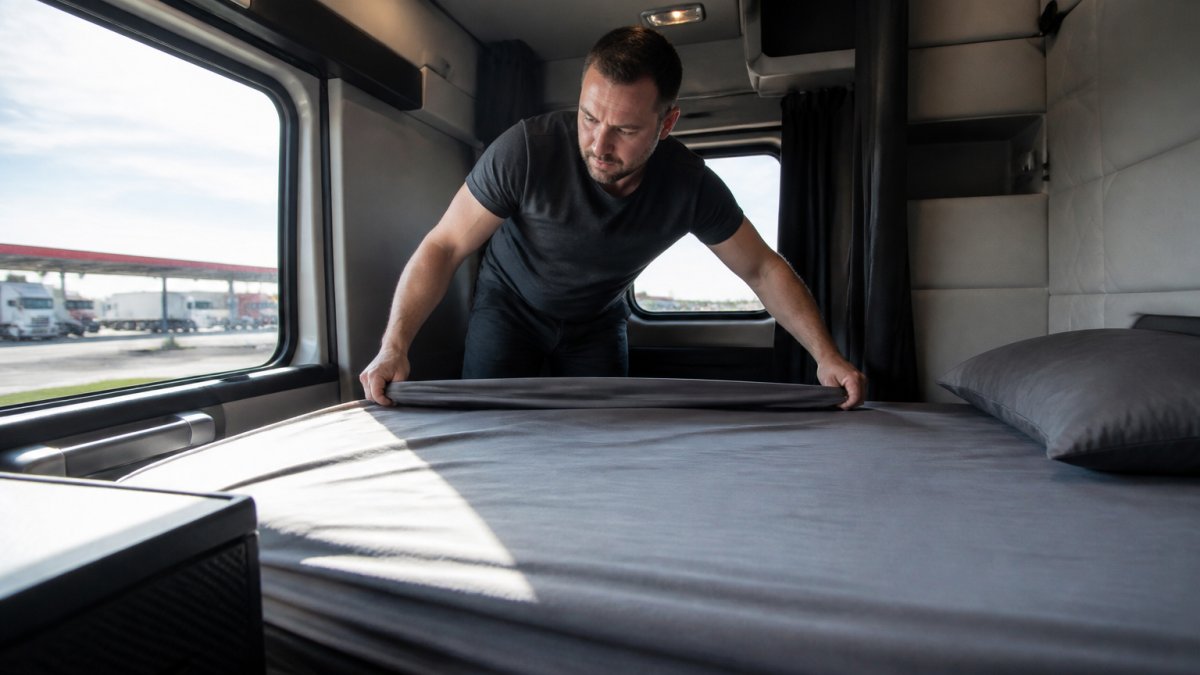
First, construction. A medium-firm profile of around 7 inches gives enough depth for real support without eating into cab headroom. Second, temperature control. Third, edge support.
That combination is exactly what we build into the Nomad truck mattress: 7 inches of medium-firm support, Thermo-Adaptive foam, made in Canada, with a 90-night trial and a 20-year warranty.
Matching Firmness and Support to Your Body Type and Sleeping Position
Firmness is personal, but it is not random. Side sleepers usually need a softer surface so the shoulder and hip can sink in without pressure building. Back sleepers do best on medium-firm support that keeps the spine neutral. Stomach sleepers need a firmer surface so the lower back does not sag.
Body weight shifts the equation. A lighter driver may find a medium-firm mattress feels firmer than expected, while a heavier driver may push through the comfort layer and feel the base.
Durability, Cleaning and Moisture Control for Life on the Road
Durability in a truck mattress is about more than foam density. It is about how the mattress handles constant vibration, repeated compression and the moisture that builds up in a small, sealed space. A waterproof base protects the foam from spills and condensation.
Air the bunk when you can. Pull the bedding back after a night’s sleep and let the mattress breathe before you make it up again. Rotate the mattress if your model allows it. These small habits extend the life of any mattress, and they matter more in a cab than in a house.
Weighing Cost, Warranty and Replacement Logistics
Price is only part of the cost of a truck mattress. The real number includes shipping, the trial period, and what happens if the mattress does not work out. A cheap mattress that you replace every year costs more than a durable one that lasts a decade.
We ship free to most areas in Canada, and every Nomad Mattress comes with a 90-night sleep trial and up to a 20-year limited warranty. You can read the full details on how the sleep trial, returns and warranty work before you commit.
Take the Nomad Mattress Comfort Quiz Before Your Next Run
You do not need to guess at firmness. Answer a few questions about your sleeping position, body type and truck, and the Nomad Mattress comfort quiz will point you to the right option. It takes a couple of minutes and saves you a return.
Every Nomad Mattress is made in Canada and built for mobile living, with Thermo-Adaptive foam that regulates temperature, a lightweight design that is easy to handle, and transfer edge support for sitting and dressing in a tight bunk.
Get started with Nomad Mattress and give your next run the recovery it deserves.
Frequently Asked Questions
What size mattress fits a semi-truck sleeper?
Sleeper berths vary by truck make, model and year, so measure the bunk opening yourself before ordering rather than trusting a spec sheet. Most bunks fall into a small set of standard sizes, and Nomad Mattress sells those standard sizes for sleeper cabs rather than custom builds. Measure length, width and the height of any lip or ledge around the bunk, then compare against the size chart on the Nomad Mattress site. If your bunk is an unusual shape, email info@nomad-mattress.com with your measurements and a photo before you buy.
What mattress materials hold up best for long haul truckers?
Multi-layer foam and hybrid builds handle constant vibration better than a basic innerspring, which can develop sagging and noise over months of road use. Look for a dense support core under a softer comfort layer, plus a breathable cover and waterproof base to manage moisture in a cab. Nomad Mattress uses Thermo-Adaptive foam that regulates temperature, which matters when a parked truck heats up fast in summer. A 20-year limited warranty is a reasonable signal that the foam is built for frequent use rather than occasional camping.
How often should a truck mattress be replaced?
Most long-haul drivers get several years from a quality foam mattress, but replacement timing depends on hours of use, driver weight and how well the mattress is protected. Watch for permanent body impressions, a support layer that feels flat, or waking with pressure points that were not there before. A waterproof cover and regular airing out will extend life considerably. Nomad Mattress backs its mattresses with a 20-year limited warranty and a 90-day sleep trial, so you can test whether a new mattress actually solves your comfort problem before committing long term.
How do I choose a mattress for a semi-truck sleeper cab?
Start with fit, then work through materials and firmness. Measure your bunk, confirm the mattress profile leaves room for bedding and any cab fixtures, then pick a construction that suits your sleeping position: side sleepers usually want more pressure relief, back and stomach sleepers a firmer surface. Consider heat and moisture, since cabs hold warmth. Nomad Mattress ships free to most areas in Canada and offers a comfort quiz that pairs drivers with a mattress based on body type and sleeping habits, which is a sensible first step before comparing sizes.
