
Durable Mattresses for Full-Time RVing: 2026 Guide

Table of Contents
- Why Full-Time RVing Destroys Ordinary Mattresses
- Durable Mattresses for Full-Time RVing: What Actually Lasts
- RV Mattress Materials: Foam, Hybrid, and Latex Compared
- RV Mattress Sizes: Short Queen, Bunk, and Measuring Your Platform
- RV Mattress Replacement: Logistics, Warranty, and Trial Periods on the Road
- Weight, Payload, and Temperature: The Trade-Offs Nobody Mentions
- How to Choose the Best RV Mattress for Your Sleep Style
- Frequently Asked Questions
Last Updated: October 17, 2026
Why Full-Time RVing Destroys Ordinary Mattresses
A mattress built for a house assumes a stable floor, steady humidity, and a consistent sleeper. An RV delivers none of that.
At Nomad Mattress, we build for that reality rather than against it.
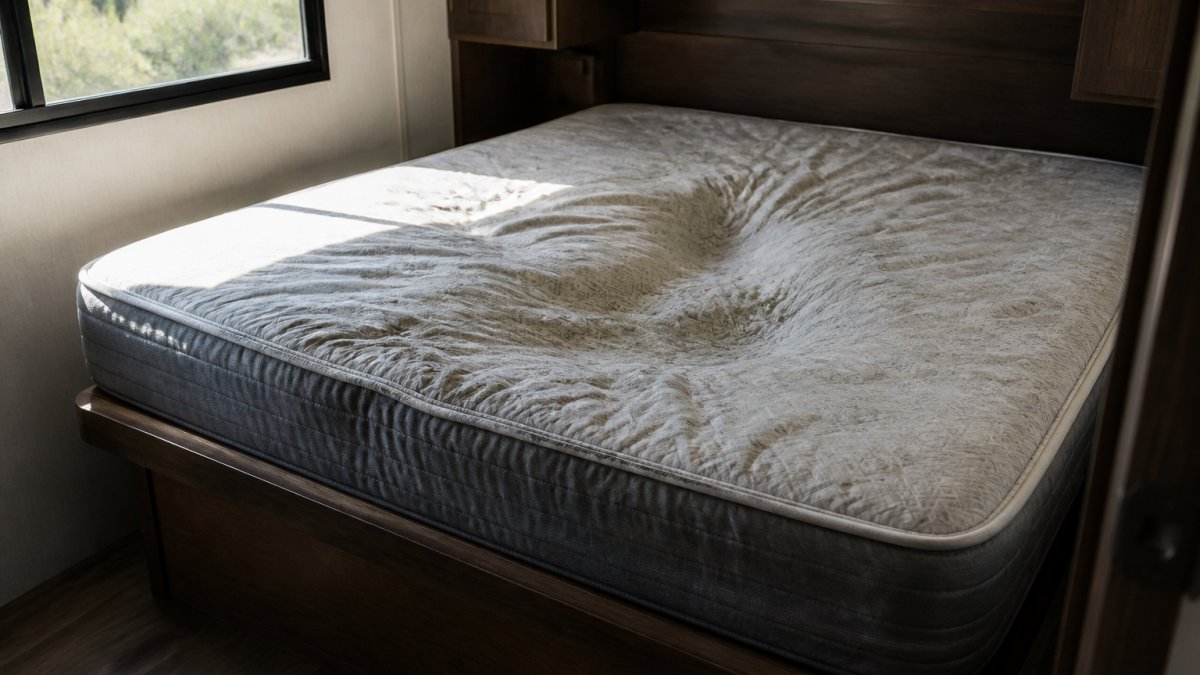
The failure pattern is predictable. Foam softens where hips and shoulders press hardest. Cheap covers trap moisture against the foam.
Ordinary mattresses also fail on fit. A residential queen is 60 by 80 inches, while many RV platforms are built to different dimensions entirely.
Durable Mattresses for Full-Time RVing: What Actually Lasts
Durable mattresses are built around core density and layer integrity, not marketing claims. The core does the load-bearing work, so a higher-density foam or latex core resists compression far better than an entry-level polyurethane block. For a full-time RVer, the question is which layers will still be doing their job after two or three years of nightly use, road vibration, and humidity cycling.
Here is how the main construction types compare for a mobile, full-time setting:
| Construction | Durability Under Daily Use | Weight | Temperature Behavior | Best For |
|---|---|---|---|---|
| High-density foam | Good to very good | Light | Warms up without airflow | Weight-sensitive rigs |
| Hybrid (foam + coils) | Very good | Heaviest | Breathes well | Couples, side sleepers |
| Latex | Excellent | Heavy | Sleeps cool | Long-term full-timers |
What Actually Wears Out First
A mattress rarely fails all at once. The failure sequence under full-time RV use is predictable, and knowing it helps you inspect a candidate before you buy.
- The comfort layer softens first. The top inch or two of foam takes the concentrated load of hips and shoulders. Low-density comfort foam develops permanent depressions within the first year of nightly use; higher-density foam and latex resist this far longer.
- The core loses rebound. Once the support core stops pushing back, the mattress feels flat even where the surface looks fine. This is the failure that ends a mattress’s useful life, and it is driven almost entirely by core density.
- Seams and the cover go next. Road vibration and repeated flexing work stitching loose, and a cover that traps moisture accelerates foam breakdown underneath it.
- Edges collapse before the center. RV platforms are often narrower than the mattress, so edges carry load they were never designed for. Sagging usually starts at the corners and perimeter.
How to Assess Construction Before You Buy
Ask for the core density, not the thickness. A thick mattress built on low-density foam sags faster than a thinner one with a dense core. Foam cores below roughly 1.8 lb per cubic foot soften quickly under daily use, while cores in the 2.5 lb range and above hold their shape noticeably longer.
Then check layer count. A single thick block of foam feels firm at first but has no graduated support, so it bottoms out under a heavy sleeper.
Buying on thickness alone is the most common mistake. A 12-inch mattress built on low-density foam will sag faster than an 8-inch mattress with a dense core. Ask what the core density is before you ask how many inches it is.
Expected Lifespan Under Full-Time Use
A mattress used every night by full-time RVers faces roughly the same load as a residential bed, plus vibration and humidity. A well-built high-density foam or latex core holds its shape noticeably longer than a low-density foam model, so full-timers should expect to replace an entry-level foam mattress far sooner. Treat the warranty length as a signal of confidence in the core, not a promise the mattress will feel new that long.
Rotation and Care to Extend Life
Rotation is the cheapest durability upgrade available. On a mattress that allows it, rotate head-to-foot every few months so the comfort layer wears evenly. Keep the cover clean and dry, air the sleeping space when you can, and avoid putting weight on the perimeter when you climb in and out. Nomad Mattress builds its mattresses around a dense, temperature-regulating core so the layers that matter most hold up under continuous use, and its 20-year limited warranty reflects that construction.
The Practical Test
Press firmly into the center and the edges. A quality core pushes back evenly and recovers quickly. If the foam collapses under hand pressure or stays compressed after you release, it will collapse under a sleeper within a year of full-time use. Do this on the showroom floor, and repeat it every few months to catch softening before it becomes a back problem.
RV Mattress Materials: Foam, Hybrid, and Latex Compared
Material choice drives lifespan, weight, temperature, and how the mattress feels after two years of nightly use. Each family of materials solves a different problem.
Foam Construction and Density
Foam density is the weight of foam per unit volume, and it is the single best predictor of how long a foam mattress will last. Higher-density foam packs more material into the same space, so it resists compression and rebounds more reliably. Low-density foam feels plush in a showroom and flattens quickly under a full-time sleeper.
Nomad Mattress uses Thermo-Adaptive foam designed to move heat away from the body rather than trap it, which matters when an RV interior climbs in temperature during a sunny afternoon.
Hybrid and Latex Construction
Hybrid mattresses pair a foam comfort layer with a coil support core. They breathe well and isolate motion, which suits couples, but the coil unit adds weight. Latex offers the best long-term resilience of the three, sleeps cool, and holds its shape under repeated load. The trade-off is weight and cost, both of which matter in a vehicle with a payload limit.
RV Mattress Sizes: Short Queen, Bunk, and Measuring Your Platform
RV mattress sizes are not standardized across manufacturers, so measure your platform before you shop. A short queen is a common RV size at roughly 60 by 75 inches, shorter than a residential queen. Bunk mattresses run smaller again, often in compact widths for a single sleeper.
Measure length, width, and the depth of any lip or surround, and note where the platform sits relative to slides and cabinetry.
Measure at the platform, not the old mattress. Mattresses compress and covers stretch, so a worn mattress can read an inch or two off. The platform is the number that decides fit.
RV Mattress Replacement: Logistics, Warranty, and Trial Periods on the Road
Replacing a mattress on the road is a logistics problem as much as a comfort one. Most mattresses ship vacuum rolled and boxed, which makes them far easier to move through a narrow RV door.
Warranty and trial terms matter more for full-timers than for homeowners, because a return from a remote location is expensive. Nomad Mattress backs its mattresses with a 20-year limited warranty and a 90-day sleep trial, so you can sleep on the mattress through real conditions before committing.
Ask three questions before buying from any provider:
- Does the trial period cover a full season of use, not just a few weeks?
- Who pays shipping if a return is needed from a remote location?
- Does the warranty cover compression and sagging, or only manufacturing defects?
Weight, Payload, and Temperature: The Trade-Offs Nobody Mentions
Payload is the trade-off most mattress guides skip. Every kilogram you add to the rig is a kilogram you cannot spend on water, gear, or passengers.
Temperature is the second hidden cost, and it is where RV sleeping differs most from home. An RV shell absorbs heat all day and releases it slowly, so a mattress that traps body heat makes for poor summer sleep.
Why Moisture Matters More in an RV
An RV concentrates moisture in a small, poorly ventilated space. Cooking, showering, breathing, and damp gear all add water vapor, which condenses on the coldest surfaces, often the mattress platform and the underside of the mattress.
A mattress sitting directly on a solid platform with no airflow underneath is the highest-risk setup. Ventilation under and around the mattress, a breathable cover, and regular airing all reduce the risk.
How Materials Behave Across Temperature and Humidity Swings
- High-density foam insulates well and warms up without much airflow, so it can sleep hot in a sun-baked shell. It also stiffens in the cold, which changes how firm it feels on a cold morning.
- Hybrid (foam + coils) breathes better than an all-foam mattress because air moves through the coil unit, and it handles humidity swings more gracefully. The trade-off is weight.
- Latex sleeps cool and resists moisture better than polyurethane foam, and it holds its feel across a wider temperature range. It is the heaviest and most expensive option.
For most full-time RVers, the right balance is a dense, lightweight foam core with genuine temperature regulation and a breathable cover. It protects payload, resists sagging, sleeps cool through the seasons, and lets moisture escape instead of trapping it against the platform.
Practical Steps to Manage Heat and Moisture
Ventilate the sleeping space daily, especially after cooking or showering. Air the bedding and, where the platform allows, lift the mattress periodically so the underside can dry. Keep the cover clean and dry, and address condensation on the platform promptly. If your rig has a solid platform with no airflow, a breathable mattress and a regular airing routine matter more than any single material choice.
How to Choose the Best RV Mattress for Your Sleep Style
The best RV mattress for you depends on how you sleep and how much weight you can spare. Match firmness and support to your sleeping position, then confirm size and weight fit your rig.
- Side sleepers need pressure relief at the shoulder and hip, which favors a softer comfort layer over a dense core.
- Back sleepers do best with medium firmness and even support along the spine.
- Stomach sleepers need a firmer surface to keep the lower back from dipping.
- Couples should weigh motion isolation and edge support, since RV beds are often narrower than home beds.
- Weight-conscious rigs should prioritize foam over hybrid or latex.
Not sure where you land? Take the quiz on the Nomad Mattress website to get paired with your best option, then confirm your platform measurements before ordering.
Frequently Asked Questions
What mattress materials hold up best for full-time RVing?
High-density foam and latex hold up best under daily use. High-density foam resists sagging longer than low-density memory foam, while latex offers natural resilience and bounce-back. Hybrid designs combine a foam base with a support layer for balanced durability. Nomad Mattress uses Thermo-Adaptive foam engineered for temperature swings and mobile environments, and backs it with a 20-year limited warranty. Avoid low-density foams that compress quickly under constant weight and heat.
How often should you replace an RV mattress?
Most RV mattresses need replacing every 5 to 8 years, but full-time use shortens that window. Factory-installed mattresses often use lower-density foam and can sag within 2 to 3 years of nightly sleeping. Watch for visible dips, morning back stiffness, or a mattress that no longer returns to shape. If you sleep on it every night, plan on a shorter lifespan than a part-time camper would. A durable replacement like a Nomad Mattress can extend that cycle considerably.
How do you measure an RV bed for a replacement mattress?
Measure the length and width of the bed platform at its widest points, then measure the depth of any slide-out or surrounding cabinetry. Check for angled walls that reduce usable space. Standard RV sizes include short queen and bunk sizes, and Nomad Mattress sells these standard dimensions. If your platform has an unusual shape, email info@nomad-mattress.com with your measurements and a photo so the team can confirm what will fit.
Do I need a specialized mattress for part-time RVing, or will a regular mattress work?
A regular home mattress can work for occasional trips, but it usually is not built for the weight limits, temperature swings, and confined spaces of an RV. Specialized mattresses are lighter, resist moisture and heat better, and fit standard RV dimensions like short queen. If you camp a few weekends a year, the difference is smaller. If you spend weeks on the road, a mattress designed for mobile living will hold its shape and comfort far longer.
Full-time RVing asks a lot of a mattress, and most ordinary beds are not built to answer. If you are tired of sagging foam and restless nights on the road, Nomad Mattress builds Canadian-made mattresses with Thermo-Adaptive foam, standard RV and sleeper cab sizing, and free shipping to most areas in Canada. Every mattress comes with a 90-day sleep trial and a 20-year limited warranty. Explore Nomad Mattress and find the durable mattress that keeps its comfort, season after season.