
Custom Size Mattresses for Sleeper Cabs: 2026 Guide

Table of Contents
- Why Standard Size Mattresses Matter for Sleeper Cabs
- Common Sleeper Cab Mattress Sizes and Dimensions
- How to Measure Your Sleeper Cab for a Mattress
- Materials and Firmness Options for Long-Haul Comfort
- Temperature Regulating Mattresses for Truckers
- Durability and High-Density Foam for Mobile Living
- Health Benefits of Quality Sleep for Long-Haul Drivers
- Nomad Mattress: Premium Canadian-Made Solutions
- Frequently Asked Questions
Last Updated: September 27, 2026
Why Standard Size Mattresses Matter for Sleeper Cabs
A long-haul driver’s sleeper cab is a mobile bedroom where sleep quality directly affects safety and health. Factory-installed mattresses rarely fit perfectly, leaving gaps or forcing awkward positioning that creates pressure points. Choosing the right standard size mattress for your sleeper cab helps close these gaps and provides proper support.
When your mattress fits snugly, you’re not rolling or waking from discomfort. Better sleep means sharper reflexes and reduced fatigue-related accidents, critical for road safety.
Nomad Mattress offers standard-size mattresses built for sleeper cabs, designed to hold up to the vibration and wear of life on the road. Below, we’ll show you how to measure your bunk and choose the size that fits best.
Common Sleeper Cab Mattress Sizes and Dimensions
Sleeper cab mattresses don’t follow standard residential dimensions. Most sleeper bunks range from 36 to 42 inches wide and 75 to 84 inches long, with significant variations by truck make and model. Understanding your specific dimensions is essential.
Standard truck sleeper configurations include:
- 36″ × 80″ (compact single): Common in older models and day cabs with minimal sleeping space
- 39″ × 80″ (mid-size single): The most frequent specification for modern sleeper cabs
- 42″ × 80″ (full sleeper): Larger sleeper units found in premium or extended-cab trucks
RV and camper bunks vary widely: Class A motorhomes may have sleeping areas 40-48 inches wide and 75-96 inches long, while Class C models are narrower and shorter.
Matching your mattress to the standard size closest to your bunk dimensions minimizes gaps and reduces time spent on unsupported areas. Use the measurements above to find the standard size that best fits your sleeper cab.
Commercial vehicle interior specifications
How to Measure Your Sleeper Cab for a Mattress
Tools You’ll Need
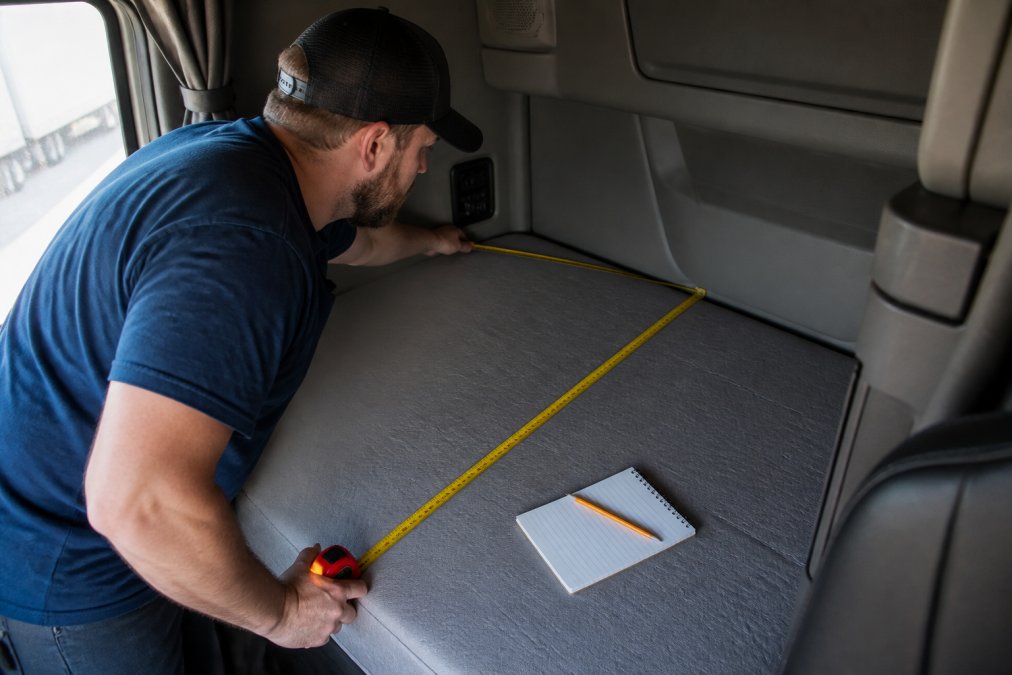
Gather a steel measuring tape, a notepad, and a camera for photos of your bunk layout.
Use a steel tape, not fabric; it maintains tension and delivers the precision manufacturers require.
Step-by-Step Measurement Process
Step 1: Measure the Length (Head to Foot) Extend your tape from the head end to the foot end. Record to the nearest quarter-inch. If the bunk tapers, measure both ends separately.
Step 2: Measure the Width (Side to Side) Measure across the bunk at three points: head, middle, and foot. Record all three; variations of 1-2 inches are normal and important.
Step 3: Check for Rounded Corners and Curves Measure the radius of rounded corners. Note any beveled or sloped edges.
Step 4: Identify Notches, Cutouts, or Obstructions Measure the location, width, and depth of each obstruction from the nearest edge. A mattress that doesn’t account for a notch will bunch uncomfortably.
Step 5: Photograph Your Bunk Take overhead and close-up photos of corners, edges, and irregular features to help manufacturers catch details measurements might miss.
Step 6: Document the Mattress Height You Need Measure clearance between your current mattress and the ceiling. Thicker mattresses provide more support but reduce headroom; thinner ones preserve space.
Materials and Firmness Options for Long-Haul Comfort
The material composition of your mattress determines how it responds to your body, how long it lasts, and how it performs in different climates. Long-haul drivers face unique demands: vibration from the road, temperature swings between day and night, and the need for a mattress that supports proper spinal alignment during extended rest periods.
High-Density Foam (4-5 PCF) resists compression and maintains support after years of nightly use, making it ideal for mobile environments.
Memory Foam conforms to your body and reduces pressure points, ideal for side sleepers. The trade-off: it retains heat, which can be uncomfortable in summer.
Firmness Levels range from soft to extra-firm:
- Soft (3-4/10): Maximum pressure relief; best for lightweight sleepers or those preferring a cradled feel
- Medium (5-6/10): Balanced support and comfort; suits most body types and sleep positions
- Firm (7-8/10): Strong support with minimal sinking; ideal for heavier sleepers or those needing spinal alignment
- Extra-Firm (9-10/10): Minimal conforming; best for back sleepers who need maximum support
Temperature Regulating Mattresses for Truckers
Temperature control is critical for sleep quality on the road. A sleeper cab‘s interior can swing 30-40°F (17-22°C) between day and night. A mattress that traps heat disrupts your sleep cycle.
Durability and High-Density Foam for Mobile Living
A mattress in a sleeper cab or RV experiences forces that residential mattresses never encounter. Road vibration, constant weight shifts from acceleration and braking, and the wear of frequent use compress foam faster and break down materials sooner. A mattress built for a stationary bedroom won’t last long in a mobile environment.
Durability factors to prioritize:
- Foam density: 4-5 PCF for long-haul environments; anything lower will compress prematurely
- Cover material: Heavy-duty, tear-resistant fabrics withstand the friction of bedding and body movement better than thin covers
- Edge support: Reinforced edges prevent the perimeter from compressing faster than the center, which creates an uncomfortable “bowl” effect
- Seam quality: Double-stitched seams resist splitting and extending the mattress lifespan
Health Benefits of Quality Sleep for Long-Haul Drivers
Poor sleep quality is a silent killer in the trucking industry. Chronic sleep deprivation impairs judgment, slows reaction time, and increases the risk of accidents. A mattress that doesn’t fit your body or regulate temperature disrupts sleep cycles, leaving you fatigued even after 8 hours of attempted rest.
- Improved spinal alignment: A mattress that conforms to your body’s natural curves supports proper spinal positioning, reducing back and neck pain that develops from poor sleeping posture
- Enhanced pressure relief: Proper support distributes your weight evenly, preventing the pain and numbness that comes from pressure points
- Better sleep continuity: Temperature regulation and proper fit reduce nighttime waking, allowing you to complete full sleep cycles
- Reduced fatigue: Uninterrupted sleep cycles improve alertness, reaction time, and decision-making, directly impacting road safety
- Long-term health: Consistent quality sleep supports immune function, reduces inflammation, and lowers the risk of chronic health conditions
Nomad Mattress: Premium Canadian-Made Solutions
Nomad Mattress stands apart in the sleeper cab and RV mattress market because they’ve engineered their solutions specifically for the realities of mobile living. Rather than adapting residential mattress designs to sleeper cabs and RVs, they’ve built from the ground up with the needs of long-haul drivers, RV dwellers, and weekend adventurers in mind.
What makes Nomad different:
Frequently Asked Questions
What size mattress is typically used in a sleeper cab?
Sleeper cab mattresses vary by truck model, but many sleeper cabs have non-standard shapes with rounded corners, wedges, or notches that require custom sizing. The best way to know your exact requirements is to measure your specific bunk, as older trucks and specialty models often have unique dimensions that standard mattresses won’t accommodate properly.
How do I measure my sleeper cab for a custom mattress?
Start by measuring the length, width, and height of your bunk at multiple points, as sleeper cabs often have slight variations. Check for rounded corners, wedges, or angled sections that might affect fit. Note any obstacles like air vents or electrical outlets. Take photos of the space from different angles and share these measurements with the mattress manufacturer. Many custom makers, including Nomad Mattress, provide detailed guides to ensure your mattress fits without gaps or shifting.
What materials are best for temperature regulation in sleeper cabs?
Thermo-Adaptive foam technology is specifically designed to regulate temperature by responding to your body heat and the surrounding environment, keeping you comfortable in both hot summers and cold winters. This material is superior to traditional memory foam, which can trap heat and become uncomfortably warm during long days parked in the sun. High-density foam combined with breathable materials and proper ventilation helps dissipate moisture and maintain consistent comfort throughout the night, which is critical for drivers spending extended hours in confined mobile spaces.
Are custom size mattresses worth the investment for long-haul truckers?
Yes, custom mattresses deliver measurable benefits. A properly fitted mattress eliminates shifting and gaps that cause poor spinal alignment and sleep disruption, directly improving sleep quality and alertness during long drives. Quality sleep reduces fatigue-related accidents and improves overall health. While custom mattresses require upfront investment, the durability of high-density foam and specialized construction means they last significantly longer than standard options, making them cost-effective over time. Many drivers report improved back health and better rest after switching to custom-fitted solutions.
Can you make a custom mattress for sleeper cabs with rounded corners or unusual shapes?
Yes. Manufacturers like Nomad Mattress and specialized custom makers can fabricate mattresses for non-standard sleeper cab configurations, including rounded corners, wedge sections, and angled spaces. The key is providing accurate measurements and photos of your specific bunk layout. Many makers offer radius corner cuts and notch options to ensure a perfect fit. This customization is one of the biggest advantages of ordering a purpose-built mattress rather than trying to adapt a standard product to an irregular space.
Quality sleep on the road isn’t a luxury; it’s essential for your health, safety, and performance as a driver. A mattress sized right for your sleeper cab and that regulates temperature transforms how you feel after hours behind the wheel. Explore Nomad Mattress and discover how standard-sized solutions engineered for mobile living can deliver the rest you deserve, night after night.