
Best Mattress for Side Sleepers 2026: Firmness Guide

By the Nomad Mattress Sleep Team · Last updated: October 2, 2026
Table of Contents
- Why Side Sleepers Need a Different Mattress
- Mattress Firmness Scale Explained for Side Sleepers
- Comparing Mattress Types for Side Sleepers
- Matching Firmness to Body Weight and Sleeping Position
- Which Nomad Mattress Is Best for Side Sleepers?
- Take the Comfort Spectrum Quiz
- Frequently Asked Questions
Why Side Sleepers Need a Different Mattress
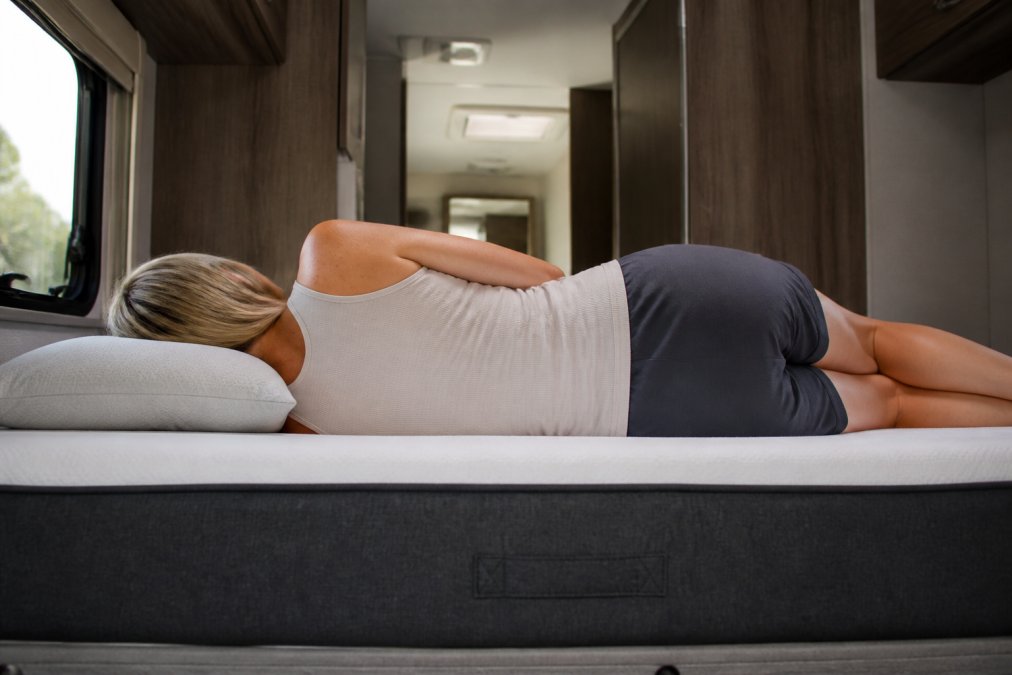
Side sleeping is the most common sleep position for adults, and it puts specific demands on a mattress. The surface has to cushion your shoulder and hip while keeping your spine level from neck to tailbone.
On your side, your weight presses into the mattress at the shoulder and hip. Too firm, and the shoulder can’t sink, which pushes your spine out of line and can leave your arm numb. Too soft, and the hips drop, bending your lower back. Either way, you wake up sore.
Pressure Points, Spinal Alignment, and Shoulder or Hip Pain
Pressure relief means the mattress spreads your weight so no single point takes the full load. For side sleepers, the shoulder and hip need to sink just enough to stay level with the spine.
Spinal alignment follows. When the mattress supports your waist without letting your hips sag, the spine stays neutral. A mattress that feels great for five minutes can still fail after two hours, because pressure builds slowly. The discomfort shows up at 3 a.m., not in the showroom.
Mattress Firmness Scale Explained for Side Sleepers
The firmness scale runs from 1 (softest) to 10 (firmest). Most side sleepers land between 5 and 7: soft enough for the shoulder to sink, firm enough to hold the hips up.
The number on a product page is a summary, not a measurement. Firmness comes from three layers working together:
- Comfort layer: how far your shoulder and hip can sink before they meet resistance
- Transition layer: how gradually the mattress moves from soft to supportive, which stops the shoulder from bottoming out
- Support core: the high-density base that holds the whole structure up
Firmness Is Not the Same as Support
Firmness is what you feel at the surface. Support is whether the core keeps your hips, waist and shoulders level once you settle in. A soft-feeling mattress can still support you if the core is dense enough; a firm one can fail if the core is thin. For side sleepers, the failure is specific: the shoulder or hip pushes through the comfort layer, hits the core too early, and the spine bends.
How to Find Your Number Without Lying on the Mattress
- Where do you wake up sore? Shoulder or arm numbness points to a surface that’s too firm. Lower-back ache points to one that’s too soft.
- How much do you weigh? Lighter sleepers generally need to move down the scale; heavier sleepers need to move up.
- Do you change position at night? Strict side sleepers can go softer. If you roll onto your back or stomach, a firmer surface protects your spine when you do.
Comparing Mattress Types for Side Sleepers
| Type | Feel | Pressure relief | Weight |
|---|---|---|---|
| Foam | Contouring | Strong | Lightest; best for RVs and trucks |
| Hybrid (foam + coils) | Responsive | Strong | Heavy |
| Innerspring | Firm, bouncy | Limited | Heavy |
Hybrids work well for many side sleepers at home, but coils add a lot of weight, which matters in an RV or truck where every kilogram counts against your payload. Foam mattresses give side sleepers strong pressure relief at a fraction of the weight, which is why every Nomad mattress is all-foam.
Matching Firmness to Body Weight and Sleeping Position
Body weight changes which firmness works. Use this as a starting point, not a verdict:
| Body weight | Firmness band | Why |
|---|---|---|
| Under 60 kg (130 lb) | Medium (about 5) | Lets the shoulder sink without a lot of body weight to push it in |
| 60–90 kg (130–200 lb) | Medium to medium-firm (5–6) | Balances shoulder cushioning with hip support |
| Over 90 kg (200 lb) | Medium-firm (6–7) with a dense core | Stops the hips from dropping |
| Combination sleepers | Medium-firm (5–6) | Protects the spine when you roll onto your back or stomach |
A Two-Minute Self-Test
- Lie on your side and have someone look at your spine from behind. It should form a straight line from the base of your neck to your tailbone.
- Slide a hand under your waist. A large gap means the surface is too firm for you; a pinched hand means it’s too soft.
- Check your pillow. If your chin points down or your head tilts up, the pillow height is wrong.
Which Nomad Mattress Is Best for Side Sleepers?
- Home & Cottage, Plush: our deepest pressure relief. A 10″ mattress with a 2″ Cool Gel-Flex memory foam top, best for side sleepers at home, at the cottage, or in motorhomes and fifth wheels with room for a 10″ mattress.
- Original Nomad RV: 7″, medium-firm, with a 2″ Thermo-Adaptive top layer. The best fit for most side sleepers in travel trailers and fifth wheels, and it won’t freeze hard on cold nights.
- Nomad Truck: the same 7″ medium-firm, Thermo-Adaptive feel in semi-truck sleeper widths.
- Nomad Slim: 6″ and firm. Choose it when headroom matters most, such as bunks and pop-ups; side sleepers who like a softer feel may prefer the Original.
Take the Comfort Spectrum Quiz
If you’re between two bands, the Comfort Spectrum quiz asks about your weight, sleeping position and temperature preferences and matches you to a comfort level, so you’re not guessing from a number. And because pressure problems show up over weeks, not one night, every Nomad mattress comes with a sleep trial: 90 nights on the Original, Truck and Home & Cottage, and 60 nights on the Hinge and Slim.
Frequently Asked Questions
What mattress firmness is best for side sleepers?
Most side sleepers do best on a medium to medium-firm mattress, about 5 to 7 on a 10-point scale. That range lets the shoulders and hips sink in enough to relieve pressure while the support core keeps the spine neutral. Lighter sleepers usually prefer the softer end; heavier sleepers need the firmer end.
Which Nomad mattress is best for side sleepers?
For homes, cottages and roomy motorhomes, the Home & Cottage in Plush gives the deepest pressure relief. In travel trailers and fifth wheels, the medium-firm Original Nomad RV is the best fit for most side sleepers.
Can a mattress be too soft for side sleepers?
Yes. A mattress that’s too soft lets the hips sink further than the shoulders, which pulls the spine out of alignment and can cause lower back pain. If you wake with a stiff back or feel like you’re rolling toward the middle, move up to medium-firm.
Do side sleepers need a different pillow?
Usually, yes. Side sleepers need a higher pillow to fill the gap between the neck and the mattress. A pillow that’s too flat drops the head and strains the neck; one that’s too high pushes the chin down.